
Chocolate University Online

"the chocolate destination...where learning and heaven unite"

CUO homeChocolate ClassesChocolate University Online StoreChocolate BlogChocolate InformationAbout CUOContact CUO
 

Subscribe to RSS Chocolate University Online Blog

brynChocolate Definitions

By Bryn Kirk on October 29, 2009 | Comments (0)

Confusion in the world of chocolate? 

You might think, “there’s nothing confusing about chocolate — you buy it, you eat it!“  The reality is, the chocolate world has its own lingo, with terms and definitions that apply to the tasting of chocolate, the baking and cooking of chocolate, and the making of chocolate confections. 
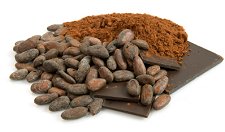
nibs, cocoa, and chocolateTo help you keep it all straight, here is a list of some common chocolate vocabulary along with their definitions…

Cocoa bean (or nib):
The cocoa bean is the seed from the pod, or fruit, of the chocolate tree — Theobroma cacao.  The cocoa bean has a shell surrounding it.  When it is removed, the nib, or the center, is revealed.  The nib is typically roasted and then crushed into chocolate liquor.

Baking chocolate (or chocolate liquor):
Baking chocolate is made from finely ground and roasted cocoa beans.  There is no sugar in baking chocolate.

Cocoa butter:
The fat present in cocoa beans is called cocoa butter.  The term “butter” does not mean that cocoa butter is a dairy product.

Cocoa powder:
Cocoa powder comes from removing the cocoa butter from the nib and then grinding the remaining solids into a powder.  The terms cocoa and cocoa powder can be used interchangeably.

Bittersweet (or semi-sweet) chocolate:
Bittersweet chocolate must contain at least 35% chocolate liquor and only cocoa butter as a fat, according to U.S. Standards of Identity.  Both bittersweet and semi-sweet chocolate terms can be used interchangeably.

Milk chocolate:
The most commonly consumed form of chocolate is milk chocolate.  Milk chocolate must contain a minimum of 10% chocolate liquor and at least 12% milk solids.  Milk fat and cocoa butter are the only fats that can be used.

White chocolate:
White chocolate is a blend of cocoa butter, milk, and sugar.  There are no chocolate solids present, which is why it lacks the typical brown color of chocolate.  U.S. regulations requires white chocolate to contain at least 20% (by weight) cocoa butter and at least 14% total milk solids.

Dutch processed chocolate:
This process darkens the color of the chocolate and releases a milder chocolate flavor.  The chocolate liquor or cocoa solids are treated with an alkaline solution.  The terms “dutched” or “alkalized” are listed on the ingredient statement for products sold in the U.S.

Chocolate flavored coating (or confectionary coating):
Chocolate that is made using a blend of vegetable fats either in addition to or other than cocoa butter.  Chocolate flavored coatings are similar in color to “real” chocolate coatings but taste very different and usually do not need to be tempered.  These coatings that contain vegetable fats cannot legally be called “chocolate” in the US.

Categories: chocolate education,fun chocolate facts
Tags: , , , , , , ,

brynAmerican Chocolate Holidays

By Bryn Kirk on October 27, 2009 | Comments (2)

Today I caught myself absent-mindedly jumping from website to website (I think this is the equivalent to channel surfing) when I landed on a site dedicated to listing American holidays.  What really caught my attention was the list of American FOOD Holidays.  Hey, did you know that each day of the year has an assigned food to worship?

Here are some examples:

  • January 16 — National Fig Newton Day
  • February 7 — National Fettuccine Alfredo Day
  • March 23 — National Chip and Dip Day
  • April 6 — National Caramel Popcorn Day
  • Chocolate HolidaysMay 7 — National Roast Leg of Lamb Day

And so on…

That all sounds real good, but as a lover of all things chocolate, a subset of the master list fits my style better:

  • National Chocolate Mint Day — February 19
  • National Chocolate Covered Raisins Day — March 24
  • National Chocolate Chip Day — May 15
  • National Chocolate Ice Cream Day — June 7
  • National Chocolate Eclair Day — June 22
  • National Chocolate Pudding Day — June 26
  • National Milk Chocolate Day — July 28
  • National Chocolate Milkshake Day — September 12
  • National Chocolate Day — October 28
  • National Bittersweet Chocolate with Almonds Day — November 7
  • National Chocolate Covered Anything Day — December 16
  • National Chocolate Day — December 28
  • National Chocolate Day — December 29

As I write this blog, October 28 is coming up fast – National Chocolate Day. Notice, there is not one, but THREE National Chocolate Days.  That’s more days than the number of national days set aside for Christmas.  Of course, you may like to recognize the Twelve Days of Christmas.  In that case three National Chocolate Days comes in second.

Take another look at the list and you’ll see this doesn’t even count Valentine’s Day, Easter, Sweetest Day, or Halloween – four more holidays that often result in the giving and consumption of chocolate!

Do you want a clever and unique idea on how to celebrate National Chocolate Day?  Give the gift of chocolate lessons.  As a student of Chocolate University Online, you or your special someone will receive a chocolate lesson filled with facts and fun EACH WEEK for 40 weeks, spanning across many chocolate holidays!   That’s even more excitement than the 12 Days of Christmas!

Categories: fun chocolate facts,shameless self promotion
Tags: , ,

cuoadminOther Fine Foods and Drinks

By Jeffrey Kirk on October 23, 2009 | Comments (0)

Recently Bryn wrote a post about experiencing fine chocolate.  I’m wondering what other fine foods and/or drinks you might enjoy?

People who have a strong love for chocolate often enjoy other fine foods and beverages as well.  Perhaps you like drinks such as coffee, wine, or scotch.  

Are you picky about your morning cup of coffee?  Do you want a gourmet blend with exquisite flavor?  Or will any dark-brown sludge do as long as its got caffeine? 

Do you like a fine French Bordeaux wine or do you pick up the $2.95 bottle of “Red?” 

How about a Single Malt Scotch from Islay or do you say, “scotch, whiskey, vodka, what’s the difference?”

You might also enjoy fine flavorful foods like cheese.  Or you might enjoy certain combinations.  Of course cheeses and wines often pair well.  Chocolate and wine pair well.  Chocolate and coffee pair well.  Perhaps chocolate and scotch pair well too.  (Hmm, I might have to try this.)

Anyway, this brings me back to the question… As a lover of chocolate what other fine food or drink interests you?  Whether it’s one I mentioned above, or something I forgot about, please give me your thoughts.

Categories: fine foods & beverages
Tags: , , , ,

brynExperiencing Fine Chocolate

By Bryn Kirk on October 13, 2009 | Comments (0)

Some people compare a fine chocolate to a fine wine.  I do too.  How about you?  If so, isn’t it about time you know what to “look for” and how to “taste” fine chocolate?

The Aroma

Smell the chocolate.  Concentrate on the intensity of the aroma and the many different scents you can identify.  Some of the most common scents in chocolate are vanilla, honey, milk, fruit, spice, and roasted nut.

If you have trouble smelling something, gently put your finger on the surface and melt a small bit of chocolate to release the aroma and try again.

The Appearance

Look at the chocolate color and shine.  The common colors of chocolate include a range of hues in browns and reds.  If you see a grayish or whitish layer on the surface, you have detected something called “bloom.”

Bloom is either sugar or cocoa butter that sits on the surface of the chocolate.  This off-color is undesirable, but not dangerous.  Bloomed chocolate is not chocolate at its best.

A properly prepared chocolate bar should have a glossy surface or nice sheen.  A dull or flat finish indicates that a poor technique was used in solidifying, or tempering, the chocolate.  A dull looking chocolate is not chocolate at its best.

The Sound

Listen to the chocolate.  Break the chocolate and hear the loud, crisp, “snap!”  The sound of the snap indicates the quality of the temper.

The Feel

Chew a piece of chocolate.  Pay attention to how it feels in your mouth.  It should feel smooth not gritty.  Also pay attention to how it melts in your mouth.  As a piece of chocolate melts in your mouth, different flavors will “come off” at different times.  There is the initial flavor, the middle flavor, and the finish.

The Flavors

Eat the chocolate.  The first sensations will probably involve sweetness and the intensity of chocolate flavor.  Most of the fruity, nutty, and/or spicy notes come off somewhere in the middle.  The final flavors could be chocolate or dairy notes and there should be no unpleasant aftertastes.

Categories: chocolate education
Tags: , ,

brynHow to Temper Chocolate (Step 2 – Finish)

By Bryn Kirk on October 8, 2009 | Comments (4)

When you buy chocolate in the store, it is already tempered.  (At least it should be!)  Basically this means it is in a stable solid form at room temperature. 

If you want to get down to the business of eating the chocolate straight out of the package, no problem, just break off a chunk and go to it!  But, if you want to use the chocolate for any other purpose you may have to re-temper.

This is the final part in my series of tempering chocolate.  The first article was about the importance of tempering chocolate.  The last article was about melting the chocolate to get ready for tempering.

Now this post explains the actual tempering process. 

There are several methods of tempering but I prefer one method over the others – I prefer the SEED METHOD.

Solidifying chocolate is all about the crystals, and the secret to success depends on time and temperature.  The seed method is my favorite way to cheat in the process. :)

Seeding releases already stable crystals into melted chocolate, thus building upon existing structures that will begin the tempering process.  It is a faster method than starting from scratch, which attempts to create crystals where none exist. 

Here is the step by step process for tempering chocolate using the seed method.

  1. Chop about 1 lb. of the chocolate into small pieces but set aside a chunk a little smaller than the size of the palm of your hand.
     
  2. Melt the chocolate by one of the methods presented in the melting the chocolate article.
     
  3. Remove the melted chocolate from the heat and drop in the saved chunk of chocolate.  Stir until the chocolate temperature drops to between 89° F to 91° F for dark chocolate or 87° to 89° F for milk chocolate.**Here is where arm strength and patience come in handy. The temperature will drop slowly, which is a necessary part of this process.  Stirring constantly will help distribute the growing crystals evenly throughout the mixture and form them into consistent sizes and shapes.
     
  4. Remove the remaining piece of solid chocolate (seed chocolate) if there is any left.  Set it aside.  (No, don’t eat it!  You still might need it.)
     
  5. Test the temper by smearing a small amount (say a teaspoon) of the chocolate on wax paper and allow it to cool for 5 to 10 minutes.  It should harden to be smooth, shiny, and dry to the touch.  If you see any dull areas, wet areas, or streaks in the hardened chocolate that indicates poor crystal development or lack of thorough mixing and stirring. If the results are not satisfactory, repeat the process by reheating the chocolate.  Use any leftover seed chocolate to begin again.

Assuming your test looks good, your chocolate is well tempered.

So now what?  What can you do with a bowl of tempered chocolate?  Yes, I know you’re thinking you can eat it.  But wait, you’ve gone through the hard work, let’s enhance something!

How about chocolate-dipped strawberries, or chocolate covered pretzels, or homemade chocolate candies.  Get the picture?  Once you’ve got a good temper you can coat anything.  Then let it harden at room temperature for a beautiful finish and great snap.

OK, stop drooling and start tempering!  You can comment below to tell me how it goes.

Categories: chocolate education
Tags: , , ,

brynMolinillo – Unique Chocolate Gift Idea

By Bryn Kirk on October 3, 2009 | Comments (1)

I like kitchen gadgets, baking tools, and small appliances.  Sometimes I even use them! (lol). I especially love chocolate paraphernalia.
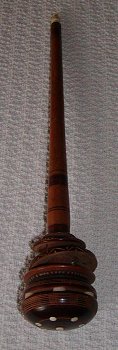
MolinilloThe molinillo (pronounced moh-lee-NEE-yoh) is the Mexican chocolate whisk.  It is a “stirrer,”  typically made of wood and used to froth warm drinks such as hot chocolate.

This tool was invented by the Spanish colonists in Mexico around the 1700′s.  The first molinillos were made to fit into a container with the handle sticking out of the top.  Then the user would rapidly rotate the molinillo between his/her palms.  The twisting motion frothed the chocolate.

Not only is this little cutie useful, but it loads of fun, too.  And it looks cool! It starts many conversations because my friends have to ask what it is and what I use it for.

I have a couple different molinillos but one in particular, the one pictured here, has an interesting story behind it.

When my son was born, a very good friend of the family who happened to be a local antique dealer, presented us with a baby gift.  She called it a Victorian era baby rattle.  The rattle is made of wood with circular discs surrounding the “neck” of the rattle and decorated with inlaid ivory.  It has a long handle with carved geometric designs, beautifully stained and varnished.  It looks attractive and interesting.  Kind of a funny looking rattle, though.

Years go by and one day I am looking online to find a Mexican Hot Chocolate recipe.  Embedded in the recipe is a link to view the recommended tool of choice, the molinillo, to froth up the chocolate drink.  When I clicked on the link, several photos of different styles of molinillos popped up and HOLY SMOKES! there is my Victorian era “baby rattle” working hard to put a creamy head of foam on a mug of hot chocolate!  I always thought it was a funny looking rattle!

Categories: chocolate gifts,fun chocolate facts
Tags: ,


Get Your FREE Ebook Now!

"101 Things You Must Know About Chocolate"

Name:
Email:

We will not share, rent, sell, or give away any information you ever provide us.  We will keep your email address secret.

Recent Posts

Sponsored Links

Tags

Categories

Archives

Interesting Links