
Chocolate University Online

"Unwrapping the Secrets of Chocolate"

CUO homeChocolate ClassesChocolate University Online StoreChocolate BlogChocolate InformationAbout CUOContact CUO
 

Subscribe to RSS Chocolate University Online Blog

avatarBanning Chocolate Milk in School Cafeterias

By Bryn Kirk on August 31, 2010 | Comments (0)

Reports show that 71 percent of the milk served nationwide is flavored, and the predominant flavor is chocolate.  Most public schools offer chocolate milk as an alternative to white milk. 

But chocolate milk is the center of controversy in many cities in the US.  The school districts of the District of Columbia; Berkeley, California; and Boulder, Colorado have already banned chocolate milk from the cafeteria.  Florida schools are considering it.

What’s the big deal? 

As you probably know, obesity among children is on the rise in the US and foods high in sugar get a lot of blame.  Of course, there are two sides to every story, and this is no exception. 

On the one hand chocolate milk is higher in sugar (almost twice as much) than white milk but on the other hand, many kids refuse to drink milk if it isn’t chocolate, and to grow up without the nutritional benefits of milk is unwise.

Milk, both chocolate and white, provides calcium, protein and vitamin D, all of which are lacking in our kids’ diets according recent studies.

Some parents say the added sugar in chocolate milk is worth the nutritional trade-off, while others say it is sending the wrong message about beverages high in sugar being part of a healthy diet.

What say you?  If you have an opinion, please comment below.  I’d love to hear your thoughts on chocolate milk in school.

Categories: chocolate in the news
Tags: , ,

avatarNovi Cioccolato

By Bryn Kirk on August 30, 2010 | Comments (1)

Novi chocolate is an Italian made chocolate from the province of Piedmont. 
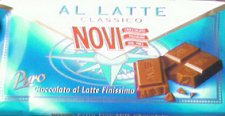
My in-laws recently traveled abroad and brought back a Novi milk chocolate bar for me.

This chocolate, called Novi Al Latte Classico, is an extra fine milk chocolate with a cacao content of 30%.

The label was in Italian but through the modern wonders of online translators, I found out what it said: “For over a century, we select the best cocoa beans, a true gift of nature. The precious beans reach our factory where they are roasted with advanced technology, while respecting tradition. We control of all stages of production, from raw material to finished product, and this ensures the uniqueness and goodness of Novi fine milk chocolate.”

This milk chocolate is smooth and velvety while it melts in your mouth.  It is very creamy, and the soft, cooked milky flavors blend well with the stronger chocolaty and nutty notes from the cacao.

I really do enjoy tasting a variety of chocolates.  Every aspect of chocolate production, including where it is made, adds a statement, subtle or grand, to the final flavor.

Ciao!

Categories: chocolate review
Tags: ,

avatarThe Shelf Life of Chocolate

By Bryn Kirk on August 29, 2010 | Comments (0)

It’s Q&A time.  Here is another question from a subscriber:

“Once chocolate has been melted, how long is it good for once it has been molded (again)?”

Chocolate is a very versatile and tolerant product to work with, the nuances of tempering aside.  Chocolate can be melted, tempered and molded, re-melted, re-tempered and re-molded, again and again. 

The shelf life of chocolate depends on whether it is milk or dark and whether or not it has inclusions like nuts, coconut, or dried fruit.

Dark chocolate lasts the longest before oxidizing, or going rancid.  Cocoa butter is a very stable fat and once chocolate is crystallized, or tempered, it can resist bloom – fat migration – fairly well. 

A good temper and a consistent environment during storage are two of the more important steps to making dark chocolate last a long time.  Typically, the shelf life of dark chocolate is nine to twelve months (I have seen it last longer).  In fact, age will actually enhance the flavor of chocolate, although it will be subtle. 

If some bloom is present on the surface of the chocolate, melt the chocolate, temper it and mold again and it will be fine.  Bloom is that grayish or whitish coating that can form on the surface of chocolate. It does not destroy the flavor of the chocolate, but the appearance is not appealing. 

Milk chocolate has a shelf life range of six months to nine months.  The main reason milk chocolate has a shorter timeline is that the milk fat (butter oil) part of the milk oxidizes or goes rancid faster than cocoa butter.  The higher the milk content in chocolate, the shorter the life span.

Adding nuts to chocolate will decrease the shelf life in terms of bloom and rancidity.  Nut oils migrate quickly to the surface of the chocolate causing bloom, and the oils behave similarly to milk fat in that they oxidize faster.

Categories: chocolate Q&A
Tags: , , , ,

avatarUltimate Raspberry Chocolate Sauce

By Bryn Kirk on August 28, 2010 | Comments (1)

Try this taste sensation over ice cream to elevate the experience of your taste buds.  Your ice cream will taste better than your usual ice cream.

Keep a bag of frozen raspberries on hand for an all year ‘round treat…

Ultimate Raspberry Chocolate Sauce
 
• 12 ounces frozen raspberries (individually quick-frozen), defrosted
• 3/4 cup Dutch-process cocoa
• 3/4 cup heavy cream
• 4 tablespoons unsalted butter, softened
• 1 1/2 cups sugar
• 1/3 cup light corn syrup
 
Puree the raspberries in a food processor fitted with a steel blade, then pass them through a fine strainer. Or pass them through a food mill. Set aside.
 
In a medium-size heavy saucepan, whisk together the cocoa and heavy cream. Add the butter, sugar, corn syrup, and raspberries and stir until well blended. Place the pan over medium heat and slowly bring the mixture to a boil, stirring often. Once it reaches a boil, let it continue to boil slowly for 8 minutes without stirring. Remove the pan from the heat and pour the sauce into a container.
 
Let it cool for 15 minutes if serving hot, or cover and refrigerate until needed. It will last for at least 1 month. The sauce may be reheated slowly. Makes 2½ cups.

Enjoy!

Categories: chocolate recipes
Tags: , ,

avatarTired Of Eating Chocolate?

By Bryn Kirk on August 27, 2010 | Comments (0)

Is it really possible to get sick of eating chocolate?

According to feedback from participants in a medical research study out of Australia, it is!  What, no way!  Sure enough, read on…

Heart patients were given 50 grams of 70% chocolate to be consumed daily as medicine during a research study on how the antioxidants in chocolate help control blood pressure.

By the end of the study, many participants said they would rather take a pill containing the antioxidants than eat any more chocolate.  About half the people in the study found the chocolate difficult to eat because of the strong flavor and about 20 percent “considered it an unacceptable long-term treatment option” over the concern for the fat and calories from the chocolate.

Although I wouldn’t have a problem eating 50 grams of 70% chocolate each day (ahem, I do eat 50 grams of 70% a day), I guess I can understand where they are coming from. First of all, if you prefer milk chocolate, dark chocolate is not going to stay palatable for very long, and second, who wants to take chocolate as medicine – dispensed like a prescription drug?  I mean, besides a freak like me?

The good news is, the study found dark chocolate to be very helpful in reducing blood pressure. 

I doubt that doctors will start handing out chocolate instead of pill prescriptions (but one can dream) so for now, eat chocolate because it is fun and has great flavor. Oh, and because it is good for you, too!

Categories: chocolate in the news
Tags: , ,

avatarFermenting Cocoa Beans

By Bryn Kirk on August 26, 2010 | Comments (0)

Did you know that one the most important steps in making chocolate taste like chocolate is cocoa bean fermentation?

Cocoa beans grow inside a thick-walled pod surrounded by a sugary pulp that provides nutrients to the beans (seeds).  The pulp is made up of about 12% sucrose which gets broken down by microbes, mostly yeasts. 

During the harvest, pods are cut down from the tree, opened, and the cocoa beans scooped out by hand.  Large mounds or heaps of pulp and beans are built in order to start the fermentation process.  To speed things along, big leaves (like banana) are used to cover the heaps in order to seal in the heat generated by the microbial action.

The temperature can reach 40C to 50C in the fermentation heap.  Many chemical reactions take place, and it is here during fermentation that chocolate acquires its color and flavor.

While the yeasts break down the sugar, ethyl alcohol and heat is produced.  Then, both the alcohol and the heat kills the yeast.  The heap has to be stirred and turned in order to aerate it and eventually stop the fermentation.  The whole process takes about 5 days.  Fermenting any longer than 5 days and the microbes will begin to attack the beans instead of the pulp.  Over-fermentation can result in creating off-flavors and odors in the cocoa beans.

The beans are dried thoroughly in the sun after fermentation to drive off all moisture and prevent further chemical and microbial activity.  At this time, the flavors are locked in and ready for transporting to the manufacturer for roasting, grinding, and making into chocolate coatings and bars.

Categories: chocolate education
Tags: ,

avatarBrownie Oatmeal Gems

By Bryn Kirk on August 25, 2010 | Comments (0)

If you can’t get enough chocolate per bite, try these babies.  And for more chocolate impact, go with the optional chocolate dipping at the end.

Brownie Oatmeal Gems
 
• 8 ounces semi-sweet chocolate, chopped
• 1/4 cup margarine or butter
• 2/3 cup light corn syrup
• 2 eggs, slightly beaten
• 1/4 teaspoon salt
• 4 cups old fashioned oatmeal
• 2/3 cup brown sugar, firmly packed
• 1 cup walnuts, coarsely chopped
 
In 2 quart saucepan, stir chocolate and butter over low heat just until chocolate melts.  Remove from heat.  Stir in corn syrup, eggs and salt. 
 
In large bowl, combine remaining ingredients.  Pour chocolate mix over dry ingredients and mix well.  Drop by tablespoonfuls on greased cookie sheet.  Bake at 350° for 15 minutes.  Cookie will not change much during baking.  Cool 5 minutes on cookie sheet.  Remove; cool completely. 
  
For Chocolate Dipped Gems: Melt 4 ounces of semi-sweet chocolate. For best results temper the chocolate.  Dip one half of each cookie in the melted chocolate.  Place on waxed paper to harden.

For the optional dipping you can simply melt chocolate and dip.  The cookies will taste good.  But if you really want them to be extraordinary, temper the chocolate before dipping.  Then the chocolate will set up hard for impressive presentation and a good snap when you eat it.

If you need a tempering refresher, refer to my How to Temper Chocolate post.

Categories: chocolate recipes
Tags:

avatarFunctional Chocolate: Snacking with Benefits

By Bryn Kirk on August 24, 2010 | Comments (0)

Chocolate for chocolate’s sake is just not cutting it anymore with consumers.  Apparently we are demanding chocolate with more meaning, purpose, and benefit.

The general term for this type of chocolate is “functional chocolate.”   Functional chocolates supply a nutritional benefit and chocolate is a good vehicle for transporting things like vitamins, probiotics, omega-3, and calcium.

In the last couple years, a few companies have introduced functional chocolates and one of them is Maramor Chocolates.  You can find some of their products at Walgreen’s and GNC stores across the nation.

The Maramor website, explains that they started as a chocolate shop inside an Ohio restaurant in 1923.  The shop made hand-crafted chocolates and sold them retail for years.  Later the shop evolved into a large scale manufacturing facility. 

Today, Maramor offers functional chocolates that include probiotic and omega-3 in both milk and dark chocolate.  They recently added a calcium truffle.

According to a 2008 consumer survey, about 21 per cent of chocolate lovers are interested in chocolate that has added functional ingredients.

Watch out, though.  Functional chocolate continues to be controversial when it comes to health claims and regulating standards.

First and foremost, I choose to eat chocolate because I enjoy the flavor, the aroma, and the luxury of something rich and decadent.  But if I am going to snack on something, it might as well be chocolatey and nutritious.

Its nice having options!

Categories: chocolate in the news
Tags: , ,

avatarKashi Cocoa Beach Granola

By Bryn Kirk on August 23, 2010 | Comments (0)

Kashi company, www.kashi.com, started in 1984 with their first creation of a  “unique blend of Seven Whole Grains and Sesame for its supreme nutritional profile — a vegetarian source of protein and complex carbohydrates that’s hearty, satisfying, and energizing.”

I recently tried their Cocoa Beach granola cereal.  The cereal has almonds, coconut, and granola clusters all coated in cocoa.

I really enjoyed this granola.  The sweetness was not overpowering and the cocoa notes blended well with the grains, nutsm and coconut flavors.  The chocolate intensity lasted throughout, even at the finish. 

I do have a particularly interesting dilemma, though.  I can’t decide which way I prefer to eat it!

Do I prefer the granola plain, popping it in my mouth as a milk-less snack? Yes, that’s a great way to eat it.  Or do I prefer it in the traditional manner, breakfast bowl style covered in milk?  That’s a great way to eat it too.

Hmm, too close to call.  Maybe I’ll alternate.

I must admit, I do like slurping up the chocolatey milk left at the bottom of my cereal bowl.

Categories: chocolate review
Tags: , ,

avatarLecithin in Chocolate

By Bryn Kirk on August 22, 2010 | Comments (0)

Take a look at an ingredient label on a bar of chocolate.  9 times out of 10 you will see soya lecithin listed there.

Is using lecithin as an ingredient in chocolate important, and what is the benefit of using it? 

Lecithin is a phospholipid typically derived from soybeans or eggs.  In its liquid form, it is a yellow-brownish fatty substance with a fairly thick viscosity.

Lecithin is very important to chocolate because it reduces viscosity, replaces expensive ingredients such as cocoa butter, improves the flow properties of chocolate, and can improve the shelf life for certain products.

Viscosity reduction, or making a coating thinner, can certainly be done by adding cocoa butter or other fats and oils, but it takes greater amounts to accomplish this and is therefore more costly. 

What percentage of lecithin is used in chocolate?

If 3.0 % or 4.0% additional cocoa butter (could be even greater depending on the viscosity of the finished product) is needed to thin down a coating, only 0.5% of lecithin would be needed to get the same result.  A little lecithin goes a long way. 

However, there is a limit for lecithin.  After 0.5%, the reducing effects on viscosity stop and can even start to go the other way and increase the viscosity.

Chocolate manufacturers know just how much to use in each formulation to maximize the advantage in viscosity.

Categories: chocolate education,chocolate Q&A
Tags: ,
Older Posts »


Get Your FREE Ebook Now!

"101 Things You Must Know About Chocolate"

Name:
Email:

We will not share, rent, sell, or give away any information you ever provide us.  We will keep your email address secret.

Sponsored Links

Social Media

Recent Posts

Tags

Categories

Archives

Interesting Links