
Chocolate University Online

"Unwrapping the Secrets of Chocolate"

CUO homeChocolate ClassesChocolate University Online StoreChocolate BlogChocolate InformationAbout CUOContact CUO
 

Subscribe to RSS Chocolate University Online Blog

avatarThe Different Types of Cacao Beans

By Joanna Maligaya on September 15, 2011 | Comments (0)

Just because there’s only one species of Theobroma cacao doesn’t mean there are no different types of cacao beans. However, even experts themselves can’t seem to agree on how many types of cacao beans there actually are, but let’s stick with 4.

Why in the world would you even care about this mumbo jumbo? Well, for starters, one word, flavor. While most of us are happily content with any chocolate in hand just as long as it’s good, true blue chocolate lovers take pleasure in the subtle differences in aroma, taste, and texture between the different cacao bean varieties.

The first type of cacao beans is the Criollo. It was initially cultivated by the Mesoamericans and is generally considered to be the most excellent worldwide. It has a rich, intricate aroma, and a profound yet smooth flavor. Criollo beans require just a little fermentation and short roasting to draw out the flavors.

The second of the types of cacao beans is the Forastero. It was originally domesticated in the Amazon basin and is very resilient and fruitful. However, it requires a long period of both fermentation and roasting for it to bring out its flavors. About 80% of all chocolate produced is derived from this particular variety but it has a bitter and plain flavor so it is usually mixed with Criollo and other chocolates to enhance its palatability.

The third one is the Trinitario variety which originated in Trinidad, where it derived its name from. Trinitario is a crossbreed of Criollo and Forastero which is why its being a separate type is arguable. These beans need medium-length fermentation to elicit the best flavors, but a short fermentation can already create acceptable ones and the roasting time can also be either short or medium. The flavor is virtually as complex as that of Criollo beans.

The last type, Nacional cacao, is extremely unusual and it is considered a Forastero so some people also refuse to consider it to be a feasible variety. It is mainly grown in western South America, particularly in Ecuador.

But whatever type it is, it’s still chocolate. And chocolate will always equal heaven, no argument there.

Categories: chocolate education,fun chocolate facts
Tags: , , , , , ,

avatarHeatwave and Chocolate

By Bryn Kirk on May 6, 2011 | Comments (0)

A heatwave?  That sounds good to me right now.  With below normal temperatures in our area throughout April (except for that one glorious day when the temperature spiked to 80), we’re left wondering if Spring will ever arrive.  Of course, it’s been said that of the 4 seasons, Wisconsin gets 3 Winters and a Summer.  So maybe we’re right on track.

Well, not all is chilly.  April 2011 was the warmest April on record for the UK, with records going back over 100 years.  For central England tempererature records go back to 1659, and this April beat them all.

So what does this heat have to do with chocolate?  It turns out that British chocolate-maker Thorntons saw below expected chocolate sales despite the Easter holiday.  They’re blaming the heat as the factor that caused people to purchase less chocolate.

This raises the question…  Is there really a bad temperature at which to eat chocolate?  Do you defer your chocolate consumption when the temperature rises?  I’d like to know your thoughts.  Please comment below.

And, if you’re in the UK, go ahead and help Thorntons get their profit back on track.  (They do ship internationally, but that’s a whole lot of shipping costs.)

Categories: chocolate in the news
Tags: , ,

avatarWorking With Chocolate and Caramel Filling

By Bryn Kirk on August 8, 2010 | Comments (0)

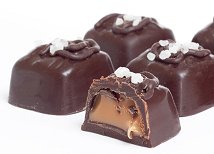
One of my email subscribers was wondering how chocolate candies made with high water content fillings, like caramel, can seemingly withstand blooming or other adverse effects?

It is true that even the smallest amount of water and chocolate don’t get along.  The combination often leads to problems like seizing and sugar bloom.  Yet, you can buy chocolate-covered caramels and see for yourself that they look good and tastes good.  They have a fairly decent shelf life, too.

So what is the secret for getting this to work?

Let me say, first of all, that it isn’t so much a secret as it is strategy.  It is a timing game.  How long can we keep nature’s forces at bay because eventually the issues between a high water content filling and the chocolate coating will come to life. 

Tip #1 – Find the right caramel formula.  During the caramel making process, boiling the ingredients will allow most of the water to evaporate and the remaining water should be trapped among the sugar solids.  But this behavior depends on the right recipe.  Finding the right formulation will take experimentation and practice.

Tip #2 – Wrap a thick coating of chocolate around the filling to slow down the migration of any water or liquid fat from reaching the surface.  You’ll know pretty quickly if the coating is not thick enough because bloom will appear early and the shelf life will be shorter than expected. 

Tip #3 – Store and package the final product correctly to prolong the arrival of bloom.  It is optimal to store at a room temperature of 70F and 50% relative humidity.

Categories: chocolate education,chocolate Q&A
Tags: , , ,


Get Your FREE Ebook Now!

"101 Things You Must Know About Chocolate"

Name:
Email:

We will not share, rent, sell, or give away any information you ever provide us.  We will keep your email address secret.

Sponsored Links

Social Media

Recent Posts

Tags

Categories

Archives

Interesting Links