
Tag Archive: cocoa beans
The Beginning of Chocolate
August 25, 2011
Chocolate has been around for millennia now, and the history is extremely long and diverse. The earliest references of chocolate were over fifteen hundred years ago in the Central American Rain Forest, an ideal environment for the cultivation of the Cacao Tree because of the mix of high rain fall, temperature and humidity.
The Mayan culture worshiped the Cacao tree as they believed it was of divine origin and it symbolized life and fertility. Cacao is actually a Mayan word which meant “God Food”, modernly coined as “Food of the Gods”. The Mayans were believed to be brewing and drinking this spicy bittersweet beverage by roasting, grinding and fermenting the seeds of the Cacao Tree. This was intended for the wealthy and elite.
The Aztecs, like Mayans, also have their own version of the fermented drink and they called it Xocolatl, meaning “bitter water”. Their Emperor, Montezuma, allegedly believed that this was an aphrodisiac, and drank almost 50 cups a day. The beans were even used as currency and considered as treasure that when Spaniards came and searched for gold and silver, they found no more than the beans.
Read more
Crio Bru
June 10, 2011
If you've known me for a while you might know that I enjoy a good cup of coffee. While it's not chocolate, it's still a flavor I look forward to.
 Well, that all might change a bit. I just learned about Crio Bru. It's a drink that is brewed like coffee, but it is made of 100% cocoa beans. Like coffee, the beans are roasted and ground. You put the grounds in your coffee maker.
And, according to a press release I read, "Crio Bru delivers the same intense, complex flavors of the finest cocoa beans found in artisan dark chocolate."
Mayan Superfood – Sweet Raw Cacao Nibs
April 11, 2011
Theobroma cacao is the scientific name for Cocoa Beans. After the cocoa beans are harvested, fermented, dried and shipped to the chocolate manufacturer, they are stripped of their outer-most coating, called the shell, and roasted before being ground into chocolate liquor (unsweetened baking chocolate).
These shelled beans are called nibs. Almost all nibs are roasted. Roasting brings out flavor and color development. Roasting also drives off moisture and undesirable “volatiles.”
I wanted to share this brief story about bean processing because RAW nibs are not roasted, and I’d like you to see where they come from and why they stand out even more as a superfood than the already proclaimed superfood-ness (is this a word?) of chocolate.
Read more
Roasting Cocoa Beans
December 2, 2010
Here is a dose of chocolate science. You know you need it from time to time!
Roasting cocoa beans serve two purposes. First, it dries the beans, and second, it develops flavor.
Driving off as much moisture in the bean is important from a food safety perspective. The lower the water content, the more difficult it is for bacteria to grow and pose a health threat.
Read more
Terrific Tannins, Terrible Tannins
November 4, 2010
Tannins are astringent, bitter compounds found in plants. Tannins cause your mouth to feel dry and pucker up. The manipulation of tannin concentration plays an important role in aging of wine and ripening fruit.
Tannins are also important to the flavor development and health benefits in chocolate...
Chocolate liquor contains about 6% tannins, significantly contributing to the bitterness of chocolate. “Bitter” as a flavor descriptor is not always a bad thing. It is true that sometimes bitter can refer to negative characteristic coming from improper fermenting or roasting. But normal amounts of tannins intensify chocolate flavor, especially at the finish.
Read more
Facts About Cocoa Butter
September 30, 2010
One of the reasons we love chocolate so much is because of the way it melts in our mouth. The velvety, luxurious melting characteristics of chocolate come from the cocoa butter.
When cacao beans are ground and pressed, cocoa butter and cocoa powder are separated. While both cocoa butter and cocoa solids are essential to making chocolate, the cocoa butter is responsible for the smooth mouth-feel and chocolatey flavor release.
The two most unique qualities of cocoa butter are its melt point and its ability to contract.
Read more
The U.S. Chocolate Market, Part II
September 7, 2010
Chocolate and cocoa can be found in so many different U.S. industries. Such products are used in the confectionery, beverage, dairy, bakery, and personal care arenas, just to name a few.
New products are being introduced at a record pace in spite of the U.S. chocolate market being considered mature. It continues to be a market place that embraces creative and innovative products.
The current market supports such variety in chocolates that it can satisfy a diverse group of consumers while at the same time keeping prices affordable.
Read more
Fermenting Cocoa Beans
August 26, 2010
Did you know that one the most important steps in making chocolate taste like chocolate is cocoa bean fermentation?
Cocoa beans grow inside a thick-walled pod surrounded by a sugary pulp that provides nutrients to the beans (seeds). The pulp is made up of about 12% sucrose which gets broken down by microbes, mostly yeasts.
During the harvest, pods are cut down from the tree, opened, and the cocoa beans scooped out by hand. Large mounds or heaps of pulp and beans are built in order to start the fermentation process. To speed things along, big leaves (like banana) are used to cover the heaps in order to seal in the heat generated by the microbial action.
The temperature can reach 40C to 50C in the fermentation heap. Many chemical reactions take place, and it is here during fermentation that chocolate acquires its color and flavor.
Read more
Look! It’s a Bean to Bar Chocolate
August 19, 2010
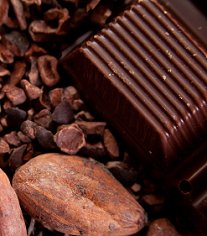 Every now and again you will come across an article, a chocolate bar, or a chocolate company that will draw attention to Bean To Bar processing.
Bean to bar means quite literally that the product was manufactured from the roasting and grinding of the bean to the tempering and packaging of the chocolate.
Read more
Grilling with Cocoa Nibs
August 7, 2010
From Martha Stewert to Scharffen Berger to the Food Network, it appears that cooking with cocoa nibs is “in”!
And why not? Besides the great flavor and a nice crunch, nibs have nutritional benefits as well. Cacao contains antioxidants that are known to reduce blood clotting, improve circulation, and help regulate blood pressure. Antioxidants also protect us from environmental pollutants and help repair damage caused by free radicals.
Cocoa or Cacao Nibs are roasted cocoa beans that have been separated from their shells/husks. You can buy them in health food stores, or online.
Scharffen Berger is a chocolate company that sells nibs online. They also have a great collection of recipes, and some of them are listed under the Savory category. One unique recipe is the nib rub for steak on the grill.
Read more