
Chocolate University Online

"the chocolate destination...where learning and heaven unite"

CUO homeChocolate ClassesChocolate University Online StoreChocolate BlogChocolate InformationAbout CUOContact CUO
 

Subscribe to RSS Chocolate University Online Blog

brynNovi Cioccolato

By Bryn Kirk on August 30, 2010 | Comments (0)

Novi chocolate is an Italian made chocolate from the province of Piedmont. 

My in-laws recently traveled abroad and brought back a Novi milk chocolate bar for me.

This chocolate, called Novi Al Latte Classico, is an extra fine milk chocolate with a cacao content of 30%.

The label was in Italian but through the modern wonders of online translators, I found out what it said: “For over a century, we select the best cocoa beans, a true gift of nature. The precious beans reach our factory where they are roasted with advanced technology, while respecting tradition. We control of all stages of production, from raw material to finished product, and this ensures the uniqueness and goodness of Novi fine milk chocolate.”

This milk chocolate is smooth and velvety while it melts in your mouth.  It is very creamy, and the soft, cooked milky flavors blend well with the stronger chocolaty and nutty notes from the cacao.

I really do enjoy tasting a variety of chocolates.  Every aspect of chocolate production, including where it is made, adds a statement, subtle or grand, to the final flavor.

Ciao!

Categories: chocolate review
Tags: ,

brynThe Shelf Life of Chocolate

By Bryn Kirk on August 29, 2010 | Comments (0)

It’s Q&A time.  Here is another question from a subscriber:

“Once chocolate has been melted, how long is it good for once it has been molded (again)?”

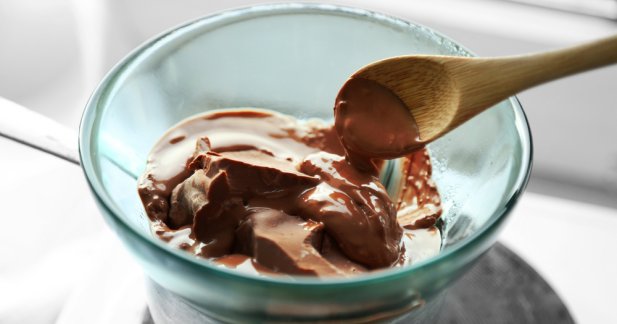
Chocolate is a very versatile and tolerant product to work with, the nuances of tempering aside.  Chocolate can be melted, tempered and molded, re-melted, re-tempered and re-molded, again and again. 

The shelf life of chocolate depends on whether it is milk or dark and whether or not it has inclusions like nuts, coconut, or dried fruit.

Dark chocolate lasts the longest before oxidizing, or going rancid.  Cocoa butter is a very stable fat and once chocolate is crystallized, or tempered, it can resist bloom – fat migration – fairly well. 

A good temper and a consistent environment during storage are two of the more important steps to making dark chocolate last a long time.  Typically, the shelf life of dark chocolate is nine to twelve months (I have seen it last longer).  In fact, age will actually enhance the flavor of chocolate, although it will be subtle. 

If some bloom is present on the surface of the chocolate, melt the chocolate, temper it and mold again and it will be fine.  Bloom is that grayish or whitish coating that can form on the surface of chocolate. It does not destroy the flavor of the chocolate, but the appearance is not appealing. 

Milk chocolate has a shelf life range of six months to nine months.  The main reason milk chocolate has a shorter timeline is that the milk fat (butter oil) part of the milk oxidizes or goes rancid faster than cocoa butter.  The higher the milk content in chocolate, the shorter the life span.

Adding nuts to chocolate will decrease the shelf life in terms of bloom and rancidity.  Nut oils migrate quickly to the surface of the chocolate causing bloom, and the oils behave similarly to milk fat in that they oxidize faster.

Categories: chocolate Q&A
Tags: , , , ,

brynChocolatier Hachez

By Bryn Kirk on August 16, 2010 | Comments (0)

In 1890 Joseph Emile Hachez, originally from Belgium, established the Bremer Hachez Chocolade Company in Bremen, Germany.

In 1922, they began producing what would become their signature product, a chocolate autumn leaf called Brown Leaves.


Brown Leaves comes in either solid milk or dark chocolate or praline leaves filled with fine nougat.  This traditional line of chocolates is only part of what they offer now.

I recently indulged in two varieties of Hachez chocolate, Cocoa d’Arriba Strawberry-Pepper and Edel Bitter-Sahne.

The Strawberry-Pepper is made with 77% cocoa from Ecuador and contains dried pieces of strawberry and spicy green peppercorns.

The strawberry flavor notes blend perfectly with the naturally fruity notes of Ecuadorian chocolate.  The heat from the peppercorns is pleasant at the back of the throat

According to the company website, www.hachez.de, Hachez uses predominantly South American cocoa varieties for its chocolate.

My next adventure was tasting the Edel Bitter-Sahne bar.  It is a creamy, dark-milk chocolate made with 43% cocoa.  The texture is soft (maybe too soft) and it melts fast.  The diary notes do not overpower the chocolate and by the end, the lingering blend of both flavors is satisfying.

Categories: chocolate review
Tags: , , , ,

brynGreen and Black’s Miniature Bar Collection

By Bryn Kirk on August 9, 2010 | Comments (0)

I am hard pressed to think of a box of chocolates that claims to be everything to everyone, but I may have hit the jack pot with Green and Black’s Miniature Bar Collection.

The collection contains milk chocolate, dark chocolate, almonds, butterscotch candy bits, crystallized ginger, dried sour cherries.  Everything’s organic.  The tasting samples are the perfect size.  Also suitable for vegetarians.  Did I miss anything?

This collection of Green and Black’s miniature bars come in six varieties;
Organic Dark 70% Chocolate, Organic Dark Ginger Chocolate, Organic Dark Cherry Chocolate, Organic Milk Chocolate, Organic Milk Butterscotch Chocolate, and Organic Milk Almond Chocolate.

The collection offers a range of intensely flavored chocolate bars.  G&B does a superb job of keeping the strongest flavors like ginger and butterscotch from overpowering the chocolate.  The chocolate coexists perfectly with each ingredient and was the last flavor to leave the mouth.  I did enjoy them all, but two stand out as my favorites; the Almond Milk and the Dark Cherry. 

Looking at the now empty package (12 lonely spaces) I realize that maybe I should have shared these with my friends and family…  Nah.

Categories: chocolate review
Tags: , , ,

brynThe Finest Camel Milk Chocolate

By Bryn Kirk on August 6, 2010 | Comments (0)

No, you did not read that wrong and I did not mistype caramel.

There is something new in the milk chocolate world – one made with camel’s milk instead of cow’s milk! 

According to the Al-Nassma Chocolate website, camel’s milk makes great milk chocolate, and it’s healthier than cow’s milk.

Camel milk contains five times more vitamin C and less lactose than cow milk.  It also contains less fat.  And camel milk may be easier on the stomach for people suffering lactose intolerance.

Al-Nassma sells their camel milk chocolate in a store next to their camel farm in Dubai, UAE.  Soon, you will be able to purchase online.

I read that the company is planning to sell their product at Harrods in London.  Guess it’s time to go visit my sister who lives there.  Wouldn’t that be cool, the two of us sipping tea and eating camel milk chocolate pralines!

Categories: chocolate in the news
Tags: ,

brynMontezuma’s Creative Chocolates

By Bryn Kirk on July 26, 2010 | Comments (0)

I can’t imagine getting bored with chocolate.  There has never been a time in chocolate history as full of imagination and creativity with chocolate as there is now. 

One of the leaders successfully bringing new and innovative flavor combinations to chocolate is Montezuma’s.

You may already know that I am a huge fan of dark chocolate and orange.  Chocolate and orange is so yesterday!  My new favorite is Dark chocolate with Orange and Geranium.

I think Montezuma’s co-founder Helen Pattinson sums it up when she says, “If you try only one bar from our range, I would recommend this best selling little number.”

The Dark Chocolate with Orange and Geranium has a rich, intense 73% minimum chocolate, adding citrus and floral notes in perfect harmony.  I was skeptical at first about having such a strong floral flavor, but since I enjoy other floral flavors with chocolate as lavender and chamomile, I thought I’d give it an open mind.

Thank goodness I did!

Speaking of having an open mind, there are other glorious chocolate discoveries at their website www.montezumas.co.uk

For the milk chocolate lover, you must try the Milk Chocolate Chilli & Lime.  It is as incredible as it is unlikely.   Just right amount of heat from the chili lingers at the back of throat after the chocolate and lime have melted away. 

No, ordinary is not part of Montezuma’s world.  Go and enjoy something extra-ordinary!

Categories: chocolate review
Tags: , , ,

brynIs Milk Chocolate Inferior to Dark Chocolate?

By Bryn Kirk on June 8, 2010 | Comments (0)

I was asked a question like this recently, “is milk chocolate considered inferior to dark chocolate?”

Inferior?  No.

Not as “in”?  Yes.

People that work in the chocolate world do not view milk chocolate as inferior to dark.  A good quality milk chocolate is just as complex in flavor as a good quality dark chocolate. 

One might argue that the milk chocolate enthusiast is at a disadvantage when it comes to experiencing the undiluted flavors of cacao.  Still, bringing forth layers of toffee and honey flavors from a precisely conched (cooked) milk chocolate is an art form.

It really comes down to your flavor profile preferences.

However, there is no disputing the fact that right now, at this moment in time, dark chocolate is The Chosen One.  Chocolate manufacturers and the press inundate consumers with messages that dark chocolate is not only better in flavor, but is better for us. 

From this point of view I can see how the “chocolate world” makes it look as if milk chocolate is inferior (and sends the milk chocolate lover into hiding).
 
Not too long ago, the opposite was true.  People had difficulty appreciating dark chocolate and it was also difficult to find. 

In the past plenty of my friends learned that my favorite chocolate contained 70% cacao and they screwed up their faces in disgust.  “How can you stand that bitter stuff?” they would ask me.  “That reminds me of the time I ate a piece of my mom’s baking chocolate out of desperation.  I could just gag!”

So, the pendulum swings back and forth.

In spite of trends, within the sphere of chocolatiers and artisans, there will always be respect and appreciation for great chocolate no matter the color.

Categories: chocolate education
Tags: ,

brynMother’s Day and Chocolate

By Bryn Kirk on May 4, 2010 | Comments (0)

Those two things, Mother’s Day and Chocolate, just fit together nicely, don’t they? 

Mother’s Day is celebrated on different days and different months depending on which country you live in.  In the United States, it is always celebrated on the second Sunday in May. 

We can thank Anna Jarvis for this great day.  She is the one credited for founding Mothers Day in the US.

How do you choose the perfect chocolate for Mom?

The choices are plentiful (overwhelming, really) and if you have not gone chocolate shopping in a while, you will be amazed at the variety of exotic new flavors and the gourmet quality of old classics.

Narrow down the choices by focusing on Mom’s fondness:

Floral:  try chocolate truffles made with lavender, rose or my favorite, orange and geranium!

Tea:  milk chocolate made with flavored teas and chai spices are absolutely delicious.

Fire:  chili peppers added to chocolate bring out the intensity of the chocolate and of course, give it a kick.

Savory:  don’t judge a book by its cover: chocolate with crystallized ginger, mushroom ganache or goat cheese taste better than you think.

Uniquewww.chocomize.com.  Just go there and check it out!

Posh:  opening a gift box of molded chocolates decorated with sprayed on cocoa butter designs, gold, and glitter will take her breath away.  They might look too beautiful to eat, but do it anyway.  They taste just as good as they look.

Now pair that scrumptious chocolate with a series of chocolate lessons to keep the experience lingering long after Mother’s Day and you’ve got a real winner of a gift!

“Man cannot live on chocolate alone; but woman sure can!”
-author unknown

Categories: chocolate gifts,shameless self promotion
Tags: , , ,

brynChocolate Adventures in England – Thorntons

By Bryn Kirk on March 11, 2010 | Comments (0)

My little niece was baptized on Valentines Day, Feb. 14, 2010 in a small church near Covent Garden in London.

Previously I had been told the English didn’t celebrate Valentines Day much, but that’s not what I experienced.  The chocolate shops and patisseries surrounding the church fully embraced the holiday with window displays decked out in red hearts, flower bouquets, and lots and lots of chocolate!

Most of the time I don’t buy chocolate truffles by the box and off the shelf because I don’t know how long ago those truffles were made.  I prefer a really fresh, handmade truffle at the corner shop.

But this day I could not resist the trimmings and trappings so I purchased a box of Thorntons Premium Collection of Truffles, Pralines and light Mousses in Milk, Dark, and White chocolate.

The verdict? Pretty good, and better than I expected!  I couldn’t decide if my favorite in the lineup was the dark chocolate covered raspberry truffle or the milk chocolate covered champagne mousse.  Both very different, yet both delicious.

According to Thorntons’ website, they have been in the chocolate-making business for nearly 100 years, with their first shop opened in Sheffield by Joseph William Thornton.  They go on to say they made a name for themselves by creating “a uniquely rich and chewy ‘special’ toffee.”  Later, after World War II, their product line was expanded to include European style soft-centered chocolates.

You can purchase Thorntons chocolates in stores and online.  Shipping is from the U.K.  If you’re in a different country, international shipping charges are quite high.  For example, shipping to the U.S. starts at £26.75.  That’ll be above $40 at today’s exchange rate.  So put in a big order to make it worthwhile. :)

Reblog this post [with Zemanta]

Categories: chocolate review
Tags: , , , , ,

brynTroubleshoot Chocolate Tempering

By Bryn Kirk on February 18, 2010 | Comments (0)

Recently I was asked about tempered chocolate that fails to keep a good shine and what can be done to fix that?  (See comments on how to temper chocolate page.)

That’s a really good question.  Concerns about the streaking and the lack of shine make me think about how temperatures, crystal development and the appearance of chocolate are all connected.

Properly tempered chocolate is shiny and uniform in color. When chocolate has streaks and does not shine, it indicates that at some point in the production process, the chocolate solidified without being in a properly tempered state.

I am sorry to have to get technical here, but see if you can follow this.  Cocoa butter has to solidify or form crystals within a narrow range of temperatures.  Tempering means all crystals become as identical in size and shape as possible and we can do this by controlling the temperatures.   

There are essentially 3 major stages in the making of chocolates that you have to be particularly careful to achieve the right temperature:

Stage 1 – The Starting Product

If you make your own chocolate candy center, like toffee or ganache, make sure it is absolutely at room temperature before you dip in chocolate.  If you don’t let it cool down enough, the heat will eventually push through your coating and cause it to lose its temper – either entirely or partially.  On the flip side, if you let the center get too cold, you essentially “shock” the chocolate.  This causes really BIG crystals to grow and the coating appears very dull, a flat finish.

If you mold your chocolates, use the molds at room temperature. This could be another source of unintended heat or cold introduced as the chocolate is solidifying.

Stage 2 – The Tempering Process

This is the most likely stage to produce streaking.

Agitating or stirring the chocolate during the tempering process is crucial to prevent streaking.  Imagine adding red food coloring to white frosting to make it pink.  If you stir in the coloring using only a few strokes, you will see streaks of red among the white. Continually stir and the frosting will eventually turn pink. Something similar happens when you temper chocolate without a thorough mixing.  Temperatures along the bottom and sides of the tempering pan will be several degrees different than its center.  Each temperature gradient grows different crystals at different rates.  This causes light to bounce and bend irregularly and we see alternating streaks of light and dark chocolate after it dries.

Too much stirring will cause air bubbles to form and get trapped within the coating.  Air bubbles cause crystals to form unevenly which gives the chocolate a grainy appearance on the surface.

If you use a tempering machine it may have separate milk, dark, and white chocolate settings.  If not, you’ll need to set up the temperature and mixing parameters differently for each type of chocolate that you use.  Milk chocolates temper at a lower temperature range than dark chocolates.  Milk chocolates are tricky because there are different percentages of milk in any given brand or formulation of milk chocolate coating. The higher amount of milk (milk fat), the lower the temperature.  White chocolates can be even more sensitive to temperature than milk chocolates. 

Stage 3 – The Cooling Process

This is the most likely stage to produce dull looking product with no shine.  The ideal temperature for cooling chocolate is between 65 and 68 F.  The relative humidity should be 50% or less.  I use a fan on a medium setting pointed right at my chocolates.  The fan will lift the humidity out of the air surrounding them.  Make sure the cooling tray is elevated off the counter top enough to let air circulate underneath and take away excess heat from the bottoms.  A refrigerator hovers around 40 F and a freezer around 30 F – these temps are too low to encourage a nice shine. Rooms that heat up during the summer spell disaster for chocolate.  Anything over 78 F is too warm and makes the chocolate soft and slightly sticky.

One obvious sign that the cooling process was unsuccessful is the formation of bloom.  Bloom is a gray dusty film that covers the surface of chocolate.  It can happen within hours, or days, after tempering and cooling.

To summarize, this particular tempering problem description appears to be a temperature issue at one of more stages of the process.

Categories: chocolate education
Tags: , , , , ,
Older Posts »


Get Your FREE Ebook Now!

"101 Things You Must Know About Chocolate"

Name:
Email:

We will not share, rent, sell, or give away any information you ever provide us.  We will keep your email address secret.

Recent Posts

Sponsored Links

Tags

Categories

Archives

Interesting Links