
Chocolate University Online Blog
Summer time is ice cream time – with hot fudge sauce of course!
Wow – it seems there are about as many different recipes for hot fudge sauce as there are types of ice cream to put them on.
From what I can tell (after reviewing many recipes) hot fudge sauce is different from ordinary chocolate sauce in that it’s really a chocolate fudge that never sets. Cream or milk, sugar, and butter are boiled until thickened so that it gets nice and gooey.
I wonder if the first hot fudge sauce was simply a fudge failure?
Fudge making appeared on the scene in American history in the late 19th century. At some point, people began to deliberately make under-cooked fudge and serve it warm over ice cream.
Here are two hot fudge sauce recipes for your eating pleasure. Enjoy!
Hot Fudge Sauce
1/4 cup butter
3 cups sugar
2 squares unsweetened chocolate
1/2 tsp salt
1 can evaporated milk
Melt butter and chocolate, then add sugar and salt. Slowly add milk and bring to a rolling boil until thickened. Serve warm over vanilla ice cream.
Microwave Hot Fudge Sauce
1 cup sugar
3 tbsp cocoa
1 stick butter
1/2 cup milk
Mix sugar and cocoa and milk. Stir. Bring to a boil in the microwave. Add butter and continue to boil until butter is completely melted. Serve warm over ice cream. |
Categories: chocolate recipes
Tags: chocolate history, fudge, ice cream, nostalgia
Peru is not known for growing cacao. It is better know for growing coca. The leaves of the coca plant are used in the production of cocaine. Coca is a much more profitable crop for farmers. Until now.
The San Martin region, after years of programs promoting cacao as an alternative crop to coca, recently won a prestigious award from the Salon du Chocolat in Paris for growing the most aromatic cacao beans.
La Orquidea is one company in Peru dedicated to growing cacao and producing aromatic, flavorful chocolates. They keep chocolate production near the fields of cacao and provide well paying jobs for women in Peru.
According to the La Orquidea website, http://www.peruvianchocolate.com/, Peruvian chocolate is high quality cacao grown in the Peruvian Amazon. The soil in this part of Peru imparts a variety of flavors that many other cacao growing countries don’t have.
They ferment and dry cacao beans and then transport a sort distance to their factory for processing. They select the most aromatic beans for their dark chocolate line because they know better beans mean better flavors.
Categories: chocolate in the news
Tags: aromas, fermentation, flavors
I was recently asked about the spread of Cocoa or Cacao trees around the world.
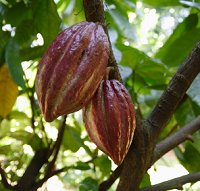
Cacao is believed to have originated in South America. There is a lot of evidence suggesting that the ancient Maya in Central America were the first to domesticate Theobroma cacao as a crop.
The Aztecs ground cacao into Xocoatl, a chocolate drink used mostly for spiritual and ceremonial rituals.
Hernan Cortés is credited with bringing cacao to Spain where it spread throughout Europe in the 1500’s and 1600’s.
Spanish friars began to grow cacao in Ecuador around 1635. The French introduced cacao to Martinique and St Lucia, the Dominican Republic, and Brazil in the mid to late 1600’s. England started growing it in Jamaica and the Dutch in Curaçao. All of this effort just to meet the ever growing demand for the affluent in Europe.
When demand exploded again in the 1800’s even more had to be cultivated. Cacao from Brazil was taken to Principe and Sao Tomé, islands off the coast of West Africa around 1830. From there, it spread to Nigeria and Ghana.
Today, the largest cacao producing country is Ivory Coast, Africa.
Categories: chocolate education, fun chocolate facts
Tags: cacao tree, chocolate history, cocoa beans, world chocolate
In the summer, it’s too hot to heat up the kitchen by turning on the oven and baking. I like to make non-baked desserts that are cool, refreshing and of course, chocolate.
Here is one recipe that is perfect and uses ingredients that I already have on hand…
Chocolate Cream Pie
1 cup semi-sweet chocolate pieces
1/3 cup milk
2 tbs. sugar
4 ounces cream cheese, softened
1 cup whipping cream
1 baked pie crust
Beat together cream cheese and sugar; set aside. Heat chocolate and milk over low heat, stirring until melted; remove from heat.
In a separate bowl, whip cream until soft mounds hold their shape. (You can substitute a cup of whipped topping for the whipping cream if you prefer.)
Beat in cream cheese mixture only until blended. Beat in chocolate mixture just until color is uniform. Turn into 9-inch baked pie shell (graham cracker, pastry, or crème de menthe). Chill at least 2 hours before serving. Garnish with shaved chocolate if desired. |
I prefer to make a graham cracker crust because I keep lots of graham crackers around in the summer for making s’mores.
I like to garnish with mini chocolate chips.
Enjoy!
Categories: chocolate recipes
Tags: chocolate dessert, chocolate pie
Dr. Jean-Philippe Chaput of the University of Copenhagen speculates that mental stress from computer work triggers changes in blood sugar levels that trick the brain into thinking it has worked off calories that need replacing. This in turn increases an appetite for sweet treats like chocolate.
This all started when Dr. Chaput noticed a supervisor regularly snacking on chocolate when doing computer work. He then asked one group of female students to go to a computer and start working while another group was told to relax for 45 minutes.
The group doing the computer-based task only burned off three more calories than the relaxing group but later they ate 230 more calories when dining at a buffet afterwards. Much of the 230 calories came from sweets and other snack foods.
Dr. Chaput says that sitting at a computer makes you gain weight because you are sedentary, and working at one makes you gain weight because it increases your appetite.
Double Whammy.
The message in all this? Take regular screen breaks and get more physical exercise, says the doctor.
Excuse me for a second as I cut this post short. I need to get up and get some chocolate.
Categories: chocolate in the news
Tags: computers, snacking, weight loss
I can’t imagine getting bored with chocolate. There has never been a time in chocolate history as full of imagination and creativity with chocolate as there is now.
One of the leaders successfully bringing new and innovative flavor combinations to chocolate is Montezuma’s.
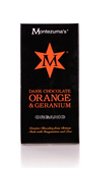
You may already know that I am a huge fan of dark chocolate and orange. Chocolate and orange is so yesterday! My new favorite is Dark chocolate with Orange and Geranium.
I think Montezuma’s co-founder Helen Pattinson sums it up when she says, “If you try only one bar from our range, I would recommend this best selling little number.”
The Dark Chocolate with Orange and Geranium has a rich, intense 73% minimum chocolate, adding citrus and floral notes in perfect harmony. I was skeptical at first about having such a strong floral flavor, but since I enjoy other floral flavors with chocolate as lavender and chamomile, I thought I’d give it an open mind.
Thank goodness I did!
Speaking of having an open mind, there are other glorious chocolate discoveries at their website www.montezumas.co.uk.
For the milk chocolate lover, you must try the Milk Chocolate Chilli & Lime. It is as incredible as it is unlikely. Just right amount of heat from the chili lingers at the back of throat after the chocolate and lime have melted away.
No, ordinary is not part of Montezuma’s world. Go and enjoy something extra-ordinary!
Categories: chocolate review
Tags: candy bars, dark chocolate, milk chocolate, world chocolate
In the opening post of this series I mentioned that there are three categories of beer that pair well with chocolates.

A second group of beers are the Belgian-style ales…
These beers are typically amber to brown in color, with high alcohol content (often greater than 8%) and are usually quite fruity in their aroma. Candy sugar (like a hard rock candy) may be added to the barley malt to increase the alcohol level without darkening the color or making it too malty.
The beer style is flavorful, yet smooth. The yeast used in these Belgian-style ales has a lot of underlying fruit tones, especially among the Trappist-style dubbels (doubles). As a result you might notice caramel, layers of banana, apple, apricot and peach, with cinnamon, nutmeg, or clove spices.
Fruit-flavored Belgian Lambic beers pair well with 60%+ cacao dark chocolate. The tartness of these fruity beers pairs nicely with the not-too-bitter dark chocolate. For an extra wow factor, combine any berry-flavored truffle or chocolate bar with dried berries and amber ale.
Amber ales are made from barley malt that, in some cases, is called “caramel malt.” This malt doesn’t really taste like caramel, but it does have an inherent sweetness and can give a nutty flavor.
Sue Langstaff, a member of the Primal Chocolate Club, has contributed this series about chocolate and beer pairing. Her company Applied Sensory, LLC offers analytical sensory services for the wine, brewing, and food industries.
Categories: chocolate education, chocolate pairings
Tags: beer, chocolate lessons, tasting
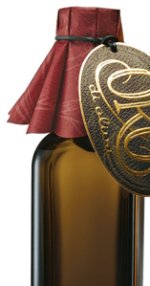
Chocolate and balsamic vinegar doesn’t sound like it would make a good couple, but I recently had a reason to try it. My sister gave me a bottle of Chocolate Balsamic Vinegar by Oro di Oliva for my birthday.
This unique vinegar makes an outstanding marinade for chicken or pork or pour it over fresh berries. On the Oro di Oliva label, it is suggested I drizzle it on ice cream – strange, but I’ll try it!
Tasting the chocolate balsamic vinegar straight, I detect a rich but basic chocolate flavor mixed with lots complex balsamic flavors. I am surprised by how well all these flavors work together.
Of course, the true test is making something and feeding it to the family. And the result?
I got compliments galore with this recipe!
Chocolate Balsamic Vinegar Truffles
8.5 ounces of your favorite dark chocolate, chopped
1/4 cup cream
2 teaspoons balsamic vinegar
1/2 cup cocoa powder, to coat truffles
(Instead of regular balsamic vinegar, I used the Chocolate Balsamic Vinegar by Oro di Oliva.)
Directions
In a small sauce pan, heat the cream over low heat until hot but not boiling. Put chopped chocolate into a small bowl, and pour hot cream over the chocolate. Let sit two minutes. Stir until chocolate is smooth and melted. Stir in the balsamic vinegar.
Cool the chocolate in the refrigerator for 1 hour or until firm but can still be easily formed into balls. It is critical to get the firmness correct and it will depend on the temperature of your refrigerator. Recheck every 15 to 30 minutes.
Place cocoa powder in a small shallow dish, like a pie dish. Use a teaspoon to scoop chocolate from bowl. Use your fingertips to shape into balls. Your body temperature will melt the chocolate and make it a little sticky, but do the best you can.
Roll the truffles around in the cocoa powder to coat, and set the chocolate balls on wax paper on a baking sheet. Serve the truffles right away or store in an airtight container in the refrigerator for up to 3 days. |
Categories: chocolate recipes, chocolate review
Tags: chocolate truffles, dark chocolate, flavors
I recently read about a new product launch from Spanish chocolates manufacturer, Pancracio. They offer several unique chocolate items but perhaps they have come up with their most unique one yet – Chocolate Pills.
This product claims all kinds of health benefits without the added sugar and fat of eating chocolate.
The pill contains 90% cocoa. It is called “one a day” – Uno Al Dia.
Personally, I’d rather eat chocolate once a day and enjoy both the flavor benefits as well as any health benefits!
Of course my curiosity drove me to visit their website, www.pancracio.com, where I discovered one of Pancracio’s specialties is the Turron.
Turrones are mostly unfamiliar to most people living in the U.S. They are typically nougat confections made of honey, sugar, egg whites, toasted almonds or other nuts, and shaped into a rectangular tablet. Pancracio has a varied selection of Turrones, enrobed in milk, dark and white chocolates.
Another interesting product is their Cocoa Pasta. It is a Fusilli pasta containing cocoa. The pasta is not sweet and I bet it is delicious served with a spicy chicken mole.
Categories: chocolate in the news
Tags: candy bars, not quite chocolate
Recently, I was asked this question: “I love the taste of chocolate and orange but when I add orange zest to my coating it curdles. Why?”
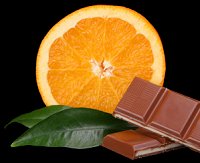
This presents an excellent technical lesson in working with chocolate.
The issue is moisture.
“Curdle” is not the correct term, but I think the idea is clear – chocolate will not function properly if moisture is introduced. Even the tiniest drop of water is problematic. When water and chocolate mix, it will “seize.”
Fresh fruit, including the peel of an orange, is moist and adding it to a chocolate coating spells disaster. For this reason, chocolate candy bars use dried fruit, candied fruit, or an oil based flavoring.
You can cheat a little (and get away with it) by adding a fruit zest or juice to a ganache and then enrobing the ganache in chocolate. If the candy is eaten within a few days, the moisture captured in the creamy center should not be a problem. Truffles tolerate this process the best. Don’t add the moisture to the coating. Instead, add it to the candy center.
Another common problem arises when dipping fresh strawberries in chocolate. Make sure you dry the outer skin completely before covering in chocolate. This will buy you some time before the moisture makes it way through the fruit and to the surface of the chocolate coating. When this happens, the moisture will destroy the appearance (with bloom) and texture (making it bumpy or grainy) of the surrounding chocolate.
Categories: chocolate education
Tags: chocolate covered fruit, chocolate lessons, working with chocolate
Older Posts »
|