
Chocolate University Online

"Unwrapping the Secrets of Chocolate"

CUO homeChocolate ClassesChocolate University Online StoreChocolate BlogChocolate InformationAbout CUOContact CUO
 

Subscribe to RSS Chocolate University Online Blog

avatarFacts About Cocoa Butter

By Bryn Kirk on September 30, 2010 | Comments (0)

One of the reasons we love chocolate so much is because of the way it melts in our mouth.  The velvety, luxurious melting characteristics of chocolate come from the cocoa butter.

When cacao beans are ground and pressed, cocoa butter and cocoa powder are separated.  While both cocoa butter and cocoa solids are essential to making chocolate, the cocoa butter is responsible for the smooth mouth-feel and chocolatey flavor release.

The two most unique qualities of cocoa butter are its melt point and its ability to contract.

Cocoa butter becomes a solid at room temperature but melts quickly at around 90°F – 95°F.  This melt point is just below our body temperature of 98.6°F and is the reason for the delightful sensation of “melting in your mouth.”  

During the process of solidifying chocolate, the liquid cocoa butter becomes solid and contracts.  This is important when molding chocolate because it allows it to “pop” out of the mold and retain its shape at room temperature.  Contraction means we can make chocolate into Easter Bunnies, candy bars, and valentine hearts.

While we call it cocoa butter, it is actually not butter at all.  It is not an animal fat like butter, it is a fat derived from the plant, Thoebroma cacao.  Because it comes from a plant, cocoa butter does not contain cholesterol.
 
Research shows that cocoa butter has a neutral effect on blood cholesterol levels.  In my book, that makes cocoa butter a good fat!  Plus, it is a naturally occurring fat, not man-made and hydrogenated like so many other fats in our diet.  Oh, since we’re on the subject, cocoa butter does not contain any trans-fats either.

Categories: chocolate education,fun chocolate facts
Tags: , ,

avatarPumpkin and Chocolate Truffles

By Bryn Kirk on September 29, 2010 | Comments (0)

It’s that pumpkin time of year.   Did you know that pumpkins have been used as food for centuries? 

Native Americans ate dried pumpkin.  Early American colonists made pumpkin into side dishes, soups, desserts, and they even made beer from it.

Pumpkin blossoms can be batter-dipped and deep-fried like squash blossoms.

Here’s a different way to eat pumpkin, as a rich chocolate truffle.

Rich Chocolate Pumpkin Truffles
 
• 2 1/2 cups vanilla wafers, crushed
• 1 cup almonds, toasted and ground
• 1/2 cup powdered sugar, sifted
• 2 teaspoons cinnamon
• 1 cup semi-sweet chocolate, chopped or shaved
• 1/2 cup canned pumpkin
• 1/3 cup coffee liqueur
• 1/4 cup powdered sugar, sifted
 
In medium bowl, combine vanilla wafer crumbs, ground almonds, the 1/2 cup powdered sugar, and cinnamon. Blend in chocolate, pumpkin, and coffee liqueur. Form into 1-inch balls. Chill. Dust with remaining powdered sugar just before serving.

Categories: chocolate recipes
Tags: ,

avatarIndonesian Chocolate is Toad-ally OK

By Bryn Kirk on September 28, 2010 | Comments (0)

The Sulawesian toad (Ingerophrynus celebensis) has hero status on cocoa farms in Indonesia. 

German and Australian agriculture scientists have discovered the amphibian predator is eliminating a nasty pest to cocoa, the yellow crazy ant (Anoplolepis gracilipes).

The yellow crazy ants got their name from their color and their zigzag scurrying behavior.  They are a non-native, invasive insect that can bring devastation to cacao crops.  They nest in large supercolonies and have super appetites, too.

Up until now, it’s been the native ants role to help keep cacao protected from certain pests and diseases, but the yellow crazy ant has pushed out the native ant species and disrupted the delicate balance within the ecosystem. 

Here is where our super hero comes in.  Every three months or so, Sulawesian toads leave their home in the forest and march through the cacao plantations to breed in the water of near by rice fields.

As they come through the cacao farms, they feast on yellow crazy ants and researchers say they can deplete a crazy ant population by one third.  The toads prefer the invader ants over the indigenous ones.

Many farmers will be trained to encourage the use of toads as free pest-control agents all year round.

Go toads!

Categories: chocolate in the news
Tags: ,

avatarGhirardelli Midnight Reverie

By Bryn Kirk on September 27, 2010 | Comments (0)

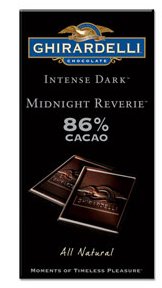
Ghirardelli Chocolate Intense Dark chocolate bars are incredibly delicious.  There are presently six in the series with two more being “voted in” by fans across the nation.

Currently the choices are Midnight Reverie, Twilight Delight, Toffee Interlude, Espresso Escape, Evening Dream, and Sea Salt Soiree.

I like them all, but my favorite is the Midnight Reverie.  This bar is not for the faint of heart at 86% cacao. 

What I enjoy most about the Midnight Reverie is the velvety texture and intense chocolatey and fruity flavors. The melt is fast, and yet the roasted cocoa notes linger for a delightful aftertaste.  For me, this bar completely satisfies.

Ghirardelli goes out of its way to enhance your tasting experience through its packaging. For example, on the back of the stiff paper label, there are the Tasting Notes written by the creators. It is so well written that just reading it makes my mouth water.

And if that is not enough, they direct you to their website to view their food and beverage pairing suggestions that complements the chocolate! 

All this for $2.29 at my local grocery store.

Enjoy!

Categories: chocolate review
Tags: , , ,

avatarPinot Grigio Great with “Dark Milk”

By Bryn Kirk on September 25, 2010 | Comments (0)

Pinot Gris, or Pinot Grigio wine is light, crisp, and dry.  I make a point these days to pair chocolate with any wine I happen to be drinking.  Since I have never put any chocolate together with a Pinot Grigio before, I had to dig into my chocolate stash and pull out things I had on hand. 

My first choice was a mid-range dark, 60% cacao solids, sourced from Ghana.  I knew that the Pinot Grigio was on the dry side and I was curious to see if the fruity notes in the chocolate would complement the wine.

Oops.  Wrong!

To start, the chocolate actually had more coffee notes than fruity notes.  It was also too bitter for the wine.  At first, the flavor was tolerable but I could not distinguish any specific flavor notes, just a clashing of “stuff.”  At the end, the aftertaste was terrible (that, too, was indescribable which is probably ok since I didn’t want anymore anyway!).

Thank goodness my next choice was much better.  I chose a milk chocolate with an Ecuador cacao content of 42% – which really made it a “dark milk” chocolate.  I love that term; it isn’t very fancy but it is descriptive!  Many typical milk chocolates will have between 10% (the minimum according to U.S. FDA standards) and 20% chocolate. 

This time the flavors of the wine, predominately floral and fruity, matched up very well with the slightly floral and elevated fruity notes in the Ecuadorian without overpowering the wine.  The creamy and caramel notes tempered the bitterness of the chocolate so I avoided the previous disastrous aftertaste.

Now you know what to have with a Pinot Grigio, if you’re so inclined.  Enjoy!

Categories: chocolate pairings
Tags: , , ,

avatarChocolate Lovers Lounge in India

By Bryn Kirk on September 24, 2010 | Comments (0)

I keep reading about the continuing surge of chocolate sales in India.  Sold mostly in urban areas, premium chocolate bars like Lindt, Ferrero, and Godiva are flying off the shelves.
 
Some of these chocolate manufacturers are setting up local factories to meet the demand.

India is embracing chocolate with all their senses.  One growing market is the chocolate lounge.  One such recent addition to the Mumbai scene is A Chocolate Affair.  It is more than a café, it is a place to savor all things chocolate. 

The décor is “chocolate,” the aroma is chocolate and, of course, the menu is sinfully chocolate.  They serve chocolate drinks (hot chocolate and milkshakes), chocolate pastries, chocolate doughnuts, chocolate ice cream and – how cool is this – chocolate pizza!

The two specialties of the house are Decadent Chocolate Belgian Waffles and Spanish Churros accompanied by chocolate dip.  Every menu item comes with a milk chocolate or a dark chocolate option.

The owner is from New Zealand and she has seen the success of the chocolate lounge in her own country as well as Australia and England.

I would love to find out more in person, but alas, plans to travel to India are not in the near future for me.  Guess I’ll just live vicariously through their twitter account: http://twitter.com/choc_affair

By the way, you can follow the Chocolate University Online twitter account at http://twitter.com/chocolateclass.

Categories: chocolate in the news
Tags: , ,

avatarDogs and Chocolate Don’t Mix!

By Bryn Kirk on September 23, 2010 | Comments (0)

If you take a bite of chocolate, you’ll want more because it tastes so good.  Your dog will do the same thing.  Dogs love the taste of chocolate.  But here’s the thing, chocolate doesn’t love dogs.  The problem is, if your dog eats too much chocolate, he/she could be ingesting a lethal dose of poison.

Why is chocolate lethal for dogs?

Theobromine is a naturally occurring stimulant, similar to caffeine, found in chocolate.  It is the theobromine that is so dangerous.  It attacks a dog’s nervous system and heart.

The symptoms will vary for each dog depending on the amount of chocolate, the size of the dog, and the type of chocolate swallowed.

Within a few hours of ingesting chocolate, a dog might vomit or have diarrhea. Later, as more of the theobromine is absorbed, the heart rate increases, causing arrhythmia, muscle twitching, increased urination or excessive panting.  If the dose is large enough, the dog may have seizures that lead to coma and perhaps death.

It isn’t easy to say how much chocolate is too much chocolate.  If a dog licks chocolate frosting off your finger, it’s not going to cause a serious problem, but if he eats the whole chocolate cake, that’s a different story. 

What if your dog eats a candy bar?  Chocolate bars have some of the highest levels of theobromine.  A Hershey’s Special Dark chocolate bar has 184 mg of theobromine.  Compared to a cup of chocolate milk with 35 mg of theobromine and you can see that the chocolate bar packs more of a punch!

Ignore those big, cute, doggy eyes begging for your chocolate treats.   Unless, of course, if those eyes belong to your husband, then you should probably share!

For more information go to www.petMD.com.

Categories: chocolate education
Tags: , ,

avatarStrawberry (or Raspberry!) Chocolate Shortcake

By Bryn Kirk on September 22, 2010 | Comments (0)

Instead of the usual birthday cake, I made something different this year for my husband’s birthday treat.  The only thing I did was change out the strawberry topping for raspberry – his preferred fruit.

Turned out to be a big hit.  Maybe I started a new tradition???

Enjoy this awesome recipe!

Strawberry (or Raspberry!) Chocolate Shortcake
 
• 1 pint strawberries, rinsed, hulled, and sliced
       or 1/2 pint raspberries, rinsed
• 1 cup sugar (reserve ¼ cup for fruit topping)
• 2 cups all-purpose flour
• 1/2 cup unsweetened cocoa powder
• 1 tablespoon baking powder
• 1/2 teaspoon salt
• 6 tablespoons unsalted butter, cut into bits and chilled
• 1/2 cup milk
• 1 teaspoon vanilla
• 1 cup heavy cream or whipped cream
• Fresh mint sprigs, for garnish
• Bottled hot fudge sauce (optional)
 
Preheat oven to 425°. Place strawberries or raspberries in medium size bowl. Gently stir in 1/4 cup sugar; toss to coat. Let stand 20 minutes, stirring occasionally.
 
Meanwhile, prepare chocolate shortcake: Combine flour, cocoa powder, remaining sugar, the baking powder and salt in large bowl. With pastry blender or 2 knives used scissor fashion, cut in butter until mixture resembles fine crumbs. Slowly add milk and vanilla, toss with fork, until mixture just come together. Add more milk one tablespoon at a time to into dough. Put dough out onto lightly floured surface. Knead lightly about 10 times. Pat or roll dough to 3/4-inch thickness. Cut out with 4-inch round fluted cookie cutter or biscuit cutter. Place on ungreased baking sheet, about 1 inch apart. Reroll the scraps and cut out more short cakes. Bake in 425° oven for 12 minutes or until wooden pick inserted into center comes out clean. Remove shortcakes to wire rack to cool completely.
 
Cut each shortcake in half horizontally. Place bottom halves on plates. Spoon some juice from strawberry or raspberry mixture over bottoms. Spoon strawberry or raspberry mixture on each bottom half, reserving a few berries for garnish. Spoon about 1/2 cup whipped cream over each. Cover with top half. Garnish with fruit and mint. Drizzle with fudge sauce if desired. Cut in half for two servings.

Categories: chocolate recipes
Tags: , ,

avatarCacao DNA Revealed!

By Bryn Kirk on September 21, 2010 | Comments (0)

Here’s some chocolate trivia few people know since its only recently been discovered:  The cacao plant has about 35,000 genes.

I looked it up and humans have about 30,000 genes.  Umm, should I be concerned?

11 years ago, the Cacao Genome Database Project was founded to sequence the genome of Theobroma cacao.  3 years ahead of schedule, the genome sequence was released on September 15, 2010!

The goal of the genome project is to provide as much genetic information as possible and as fast as possible.  A cacao tree takes up to 5 years to mature and start producing.  It is more beneficial to the farmer to find out if the tree has any weaknesses, such as vulnerability to disease, at the seedling stage.

Mars Inc. (makers of M&M’s) funded the project.  They hope the information has a positive impact on cacao farmers by helping them stay in business longer and giving the world a more sustainable and stable chocolate supply.

Gotta go.  I have a genome sequence to explore.  Care to join me? http://www.cacaogenomedb.org/

Categories: chocolate in the news,fun chocolate facts
Tags: ,

avatarBreyers All Natural Chocolate Ice Cream

By Bryn Kirk on September 20, 2010 | Comments (0)

I noticed something interested the other day while grocery shopping.  Breyers has changed its chocolate ice cream.  It says so right there on the package, “Now with 33% more real Dutch Cocoa!”

I was intrigued.  My scientific self pondered what kind of formulation adjustments had to be made to compensate for the increase in pH from the cocoa (“dutch” means processed with alkali).  Don’t laugh, my brain works differently.

I have mentioned in past blog posts why it is necessary to add a Dutch-Processed or Alkalized Processed cocoa powder to dairy products like ice cream and milk.  Dutch cocoa is treated with an alkali to neutralize its acids.  Acidity has a negative effect on diary – it causes it to curdle. 

I know you are dying to know why this happens.  When you add acid to milk, let’s say lemon juice for example, the positively charged proteins are attracted to negatively charged caseins and they begin to clump together.  When the clumps become big enough to see, we call that curdling.  That’s good if you want to make cheese curds, and bad if you want a smooth chocolate ice cream!  So in dairy applications, Dutched cocoa has a clear benefit.

I was about to continue on my way down the aisle when my primal self forced me to buy the ice cream (I never argue with myself in matters of food, especially chocolate).

As usual, Breyers did a superb job.  The cocoa enhancements really did bring out extra chocolate flavor notes while remaining rich and creamy and velvety smooth.

Enjoy some!

Categories: chocolate education,chocolate review
Tags: , , ,
Older Posts »


Get Your FREE Ebook Now!

"101 Things You Must Know About Chocolate"

Name:
Email:

We will not share, rent, sell, or give away any information you ever provide us.  We will keep your email address secret.

Sponsored Links

Social Media

Recent Posts

Tags

Categories

Archives

Interesting Links