
Tag Archive: chocolate coating
Local Chocolates in the Philippines – A Childhood Dream
March 1, 2022
When you think of your childhood, what do you remember?
For Filipinos, being rewarded with their favorite local goodies definitely hits memory lane!
Jelly Belly Chocolate Dips
February 13, 2012
Jelly Belly makes chocolate coated jelly beans called Chocolate Dips, and they are addicting!
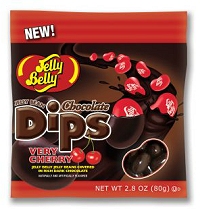 Never before had it crossed my mind, while eating a jelly bean, that it might taste better wrapped in chocolate. And, yet, here I am munching on Very Cherry flavored Chocolate Dips and I can't stop. The whole bag is gone, and so is my shapely waist. 🙂
These jelly beans weren't just grabbed off the line and thrown under a chocolate curtain. The jelly beans have definitely been altered because there is no hard sugar shell. The bean has been panned (rolled around in a revolving drum while being sprayed with a thin chocolate coating) with the chocolate covering the gooey jelly bean center.
The dark chocolate coating is a real chocolate made with cocoa butter. The chocolate by itself lacks a strong chocolatey flavor. Nonetheless, it is chocolatey enough! Besides, you don't want to melt away the coating first. Instead, chew up the combination together to get the full enjoyment of fruit and chocolate. The texture is perfect.
I thought the cherry Jelly Bellies was evenly balanced, neither the chocolate nor the cherry overpowering the other.
In addition to cherry, there are orange, raspberry, coconut, strawberry, and mint flavors.
To me, jelly beans are really sweet, too sweet, and I can eat only a few. The best thing about the chocolate dips is that the sweetness is toned down and a pretty authentic flavor replaces it.
The six flavors of dips get an OMG! declaration from me.
White Chocolate Pretzels
September 21, 2011
White chocolate covered pretzels are nearly compulsory for the holidays, but they're just as good to have just because.
Did you know that the original version of the pretzel was a strip of dough, given to children as a reward for memorizing parts of the Bible? It was then called "pretiola" which is Latin for "reward." It rapidly became popular and was prepared in other parts of Europe such as Germany, the country that coined the term "bretzel" which eventually changed into "‘pretzel."
The crunch of the pretzel coupled with the sumptuousness of the chocolate covering never fails to leave people asking for more! You can either immediately bite while enjoying chocolate covered pretzels or let the chocolate melt in your mouth first before enjoying the pretzel.
Read more
Chocolate Covered Potato Chips
September 14, 2011
The temptation of chocolate-covered anything is indeed hard to resist. And almost anything can be covered in chocolate nowadays so people keep finding out more and more attention-grabbing and out of the ordinary combinations of chocolates and certain food.
I even heard someone jokingly saying, and I am paraphrasing, “I will eat anything covered in chocolate. You can cover a tennis shoe in chocolate and I’d still eat it.” Yes, you read right. Chocolate can certainly get the best out of us sometimes! Haha
Potato chips are one of the most popular and craved snacks enjoyed by many individuals worldwide. It is reportedly one of the most consumed food items next to rice. It is typically sliced thinly and deep fried in oil to come up with crispy potatoes that’s why it is also known as “crisps”.
Read more
Thinning Out Candy Coating
October 3, 2010
You have some choices when it comes to molding and dipping using chocolate coatings.
There are chocolate-flavored confectionery coatings and there are what is commonly referred to as “real” chocolate coating or “pure” chocolate coatings.
The main difference between these two types of coating is the fat system. Confectionery coatings are made with vegetable fats and oils like palm kernel, soybean, or a blend of similar kinds. Chocolate coating is made with cocoa butter. These coatings behave very differently because of the type of fat in them.
Read more
The Secret (and Science) of Ice Cream Coatings
September 2, 2010
There are two basic types of chocolate ice cream coatings, “real” chocolate coatings and chocolate flavored compound or confectionery coatings.
Both types of coatings must be thin enough to cover and bend over the ice cream, thick enough not to crack open and let the ice cream seep through, and simultaneously be crunchy and melt in your mouth. That’s not asking too much, is it?
Most of these demands have to be met by the fat system used in the coating.
Read more