
chocolate education
Orange Zest Seized My Chocolate
July 22, 2010
Recently, I was asked this question: “I love the taste of chocolate and orange but when I add orange zest to my coating it curdles. Why?”
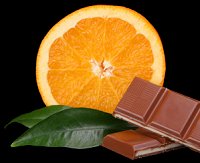 This presents an excellent technical lesson in working with chocolate.
The issue is moisture.
Read more
Defining “Quality” Chocolate
July 14, 2010
Every chocolate shop I visit insists that their chocolate is the best quality, gourmet, premium. So, when talking about chocolate, what does “quality” mean exactly?
The U.S. FDA has produced formal standards of identity that legally define chocolate and all its related ingredients and by-products. But, read through all that and you will discover there is nothing that defines the “quality” of chocolate.
Of course there are standards of “Quality Assurance” within each processing step of making chocolate. These control standards start with the cocoa bean and follow through to the finished product. But following these rules means that pretty much any final chocolate available for purchase could be defined as being a “quality” chocolate.
Read more
Chocolate and Beer Pairing – Stouts
July 9, 2010
In the opening post of this series I mentioned that there are three categories of beer that pair well with chocolates.
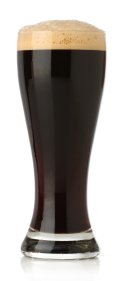 The first group for pairing includes dark beers such as porters and stouts...
These beers are made using a good deal of roasted or burnt barley malt. In fact, one of the burnt barley malts is even called “chocolate malt.” It doesn't really have any chocolate in it, but rather the malt has been roasted or kilned until it acquires more of a chocolaty color.
Read more
S’mores
July 5, 2010
A S’more is considered a summer time classic by many. It brings back memories of camping and backyard barbeques. And, of course, it just tastes good.
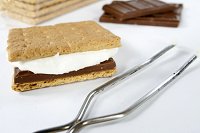 If you are not familiar with s’mores, it is like a marshmallow and chocolate sandwich with the bread replaced with graham crackers. First roast a marshmallow skewered on the end of a long stick or fork over the coals of a camp fire or grill.
Meanwhile put a piece of chocolate on a graham cracker. After the marshmallow turns a golden brown, you pull it off the stick, place it on top of the chocolate, and top with another graham cracker. The warm marshmallow melts the chocolate and voilà! a s’more is born.
Read more
Does Fair Trade Chocolate Taste Good?
June 24, 2010
What is Fair-trade chocolate, and does it taste as good as non-fair trade chocolate?
The Fair Trade chocolate model is intended to ensure cacao farmers receive a fair price for their harvest. Fair trade seeks to create more trade links between farmer and buyer with the intent of eliminating the “middleman.”
It is about sustainability, responsible farming, and supplying a community of growers with better education, health care, and the elimination of child and slave labor. It all sounds like good stuff.
Chocolate and Beer Pairing
June 16, 2010
When most people think about pairing chocolate with an alcoholic beverage the product they usually consider is wine. However, there are components in wine which can make these pairings difficult and often unpredictable.
Tannins in red wine can make dark chocolates seem more bitter, and the acidity in wines often does not balance well with the chocolate. Because of the variation in wine styles, even within varietals, it’s often difficult to generalize about ideal wine and chocolate pairings.
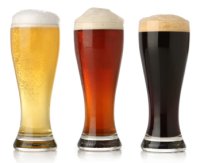 This is not the case for beer!
Read more
Is Milk Chocolate Inferior to Dark Chocolate?
June 8, 2010
I was asked a question like this recently, "is milk chocolate considered inferior to dark chocolate?"
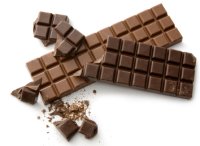 Inferior? No.
Not as “in”? Yes.
Read more
Hints for Molding Chocolate
May 10, 2010
This is the second part of the series. If you missed the first part, or you'd like a review, please see Tips for Molding Chocolate.
Now that you're caught up, here are my Extra Special Helpful Hints when working with chocolate molds.
Read more
Tips for Molding Chocolate
April 29, 2010
Molded Chocolate (not to be confused with moldy chocolate!), or chocolate from molds (moulds), has been around for a long time.
Most chocolate molds are made of either metal or plastic. They can be flat, to shape chocolate like a candy bar, or three dimensional, to shape like an Easter bunny.
If you are a beginner at working with chocolate, start with a flat plastic mold with small cavities of simple shapes. You can buy these at craft stores or baking/candy supply stores or online at a number of candy-making supply websites.
Read more