
Chocolate University Online

"the chocolate destination...where learning and heaven unite"

CUO homeChocolate ClassesChocolate University Online StoreChocolate BlogChocolate InformationAbout CUOContact CUO
 

Subscribe to RSS Chocolate University Online Blog

brynTroubleshoot Chocolate Tempering

By Bryn Kirk on February 18, 2010 | Comments (0)

Recently I was asked about tempered chocolate that fails to keep a good shine and what can be done to fix that?  (See comments on how to temper chocolate page.)

That’s a really good question.  Concerns about the streaking and the lack of shine make me think about how temperatures, crystal development and the appearance of chocolate are all connected.

Properly tempered chocolate is shiny and uniform in color. When chocolate has streaks and does not shine, it indicates that at some point in the production process, the chocolate solidified without being in a properly tempered state.

I am sorry to have to get technical here, but see if you can follow this.  Cocoa butter has to solidify or form crystals within a narrow range of temperatures.  Tempering means all crystals become as identical in size and shape as possible and we can do this by controlling the temperatures.   

There are essentially 3 major stages in the making of chocolates that you have to be particularly careful to achieve the right temperature:

Stage 1 – The Starting Product

If you make your own chocolate candy center, like toffee or ganache, make sure it is absolutely at room temperature before you dip in chocolate.  If you don’t let it cool down enough, the heat will eventually push through your coating and cause it to lose its temper – either entirely or partially.  On the flip side, if you let the center get too cold, you essentially “shock” the chocolate.  This causes really BIG crystals to grow and the coating appears very dull, a flat finish.

If you mold your chocolates, use the molds at room temperature. This could be another source of unintended heat or cold introduced as the chocolate is solidifying.

Stage 2 – The Tempering Process

This is the most likely stage to produce streaking.

Agitating or stirring the chocolate during the tempering process is crucial to prevent streaking.  Imagine adding red food coloring to white frosting to make it pink.  If you stir in the coloring using only a few strokes, you will see streaks of red among the white. Continually stir and the frosting will eventually turn pink. Something similar happens when you temper chocolate without a thorough mixing.  Temperatures along the bottom and sides of the tempering pan will be several degrees different than its center.  Each temperature gradient grows different crystals at different rates.  This causes light to bounce and bend irregularly and we see alternating streaks of light and dark chocolate after it dries.

Too much stirring will cause air bubbles to form and get trapped within the coating.  Air bubbles cause crystals to form unevenly which gives the chocolate a grainy appearance on the surface.

If you use a tempering machine it may have separate milk, dark, and white chocolate settings.  If not, you’ll need to set up the temperature and mixing parameters differently for each type of chocolate that you use.  Milk chocolates temper at a lower temperature range than dark chocolates.  Milk chocolates are tricky because there are different percentages of milk in any given brand or formulation of milk chocolate coating. The higher amount of milk (milk fat), the lower the temperature.  White chocolates can be even more sensitive to temperature than milk chocolates. 

Stage 3 – The Cooling Process

This is the most likely stage to produce dull looking product with no shine.  The ideal temperature for cooling chocolate is between 65 and 68 F.  The relative humidity should be 50% or less.  I use a fan on a medium setting pointed right at my chocolates.  The fan will lift the humidity out of the air surrounding them.  Make sure the cooling tray is elevated off the counter top enough to let air circulate underneath and take away excess heat from the bottoms.  A refrigerator hovers around 40 F and a freezer around 30 F – these temps are too low to encourage a nice shine. Rooms that heat up during the summer spell disaster for chocolate.  Anything over 78 F is too warm and makes the chocolate soft and slightly sticky.

One obvious sign that the cooling process was unsuccessful is the formation of bloom.  Bloom is a gray dusty film that covers the surface of chocolate.  It can happen within hours, or days, after tempering and cooling.

To summarize, this particular tempering problem description appears to be a temperature issue at one of more stages of the process.

Categories: chocolate education
Tags: , , , , ,

brynDipping Pretzels in White Confectionery

By Bryn Kirk on December 11, 2009 | Comments (1)

A couple days ago my children had a “snow day” off of school.  There was a good, old fashioned, Midwestern winter storm and school was cancelled.  We found our selves homebound and looking for something fun to do. 

Days like this usually drive us to the kitchen where we bake our favorites; cookies or chocolate cake.  Sadly, I did not have all the ingredients on hand for cookies or cake.  (Mental note:  keep the shelves stocked with these items!)

My daughter really wanted something sweet so we looked in every cupboard and took inventory of what we had.  Then we put on our thinking caps! 

Of the various odds and ends that we discovered in the house here are the items we concluded were compatible:  ½ bag of white baking chips, ½ bag of mini pretzels, and a partial container of colorful decorating sprinkles.  Time for some dipping!

I melted the baking chips in the microwave very carefully because white confectionery can burn easily.  I started with 30 seconds on high, stirred, and returned for a couple more 30 second bursts followed by stirring until completely melted. 

White baking chips do not contain cocoa butter so I did not have to temper it.  But, as soon as we started dipping, we realized that the melted goo was too thick to properly coat the pretzels.  Now what? 

Well, since these were not “white chocolate” chips, but rather a confectionery chip, they were made of a vegetable oil other not cocoa butter.  Therefore I could add a teaspoon of canola oil and have no worries about incompatibility between oils.  (I would never risk thinning out a cocoa butter based coating using cooking oil.  That would spell disaster so you should avoid that thought as well.)

After thinning the confectionery with the canola oil, we resumed dipping.  As each was completed, we put them on a sheet of wax paper.  While the coating was still liquid we added sprinkles and then allowed 10 minutes for the coating to cool and harden.

Ah, they looked picture perfect and tasted supreme.  It was so nice to have an easy, fun, and delicious afternoon with a loved one.  Here’s to more snow days!

Categories: chocolate recipes
Tags: ,

brynIs White Chocolate Really Chocolate?

By Bryn Kirk on November 18, 2009 | Comments (0)

Yes and No.

White chocolate is a blend of cocoa butter, milk, sugar, and vanilla.  There is no chocolate liquor (chocolate solids) present, so, can you really call it chocolate?  Perhaps not.

However, there is a legal definition for white chocolate to separate it from other “white stuff,” so perhaps yes.

According to U.S. regulations, white chocolate needs to be at least 20% cocoa butter and at least 14% total milk solids.

Beware – there are white chocolate look-a-likes out there!

If white chocolate doesn’t contain cocoa butter then it is made with a vegetable fat like partially hydrogenated palm kernel oil.  A product containing this type of fat is called white confectionery coating and cannot be called white chocolate.  White confectionery coating can also be called white almond bark or white candy coating.

I think white chocolate looks and tastes remarkably different than white confectionery.  Compare these two items sometime, side by side, and you’ll understand what I mean. 

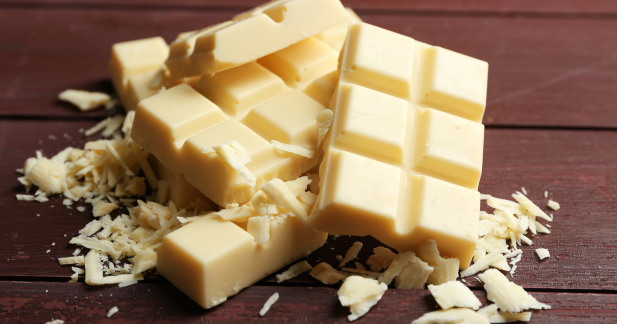
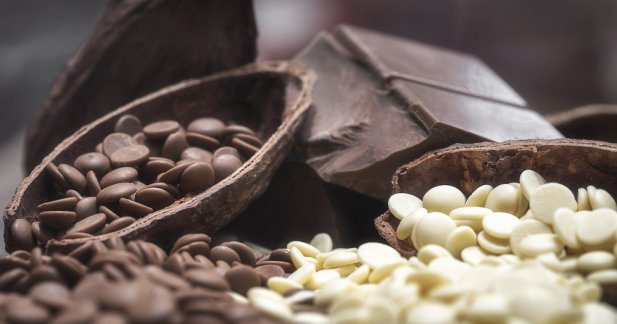
Look at the difference.  The first thing you will notice is that white chocolate looks pale yellow when compared to white confectionery.  This color difference is due to the cocoa butter which is naturally more yellow in color than other vegetable oils.

Taste the difference.  The cocoa butter in white chocolate provides a subtle, but distinct “chocolate” flavor which is lacking in white confectionery coating.  More often than not, white confectionery coatings are sweeter and less milky tasting than white chocolate.

Now that you know the difference, which do you prefer?

Categories: chocolate education, fun chocolate facts
Tags: , ,

brynChocolate Definitions

By Bryn Kirk on October 29, 2009 | Comments (0)

Confusion in the world of chocolate? 

You might think, “there’s nothing confusing about chocolate — you buy it, you eat it!“  The reality is, the chocolate world has its own lingo, with terms and definitions that apply to the tasting of chocolate, the baking and cooking of chocolate, and the making of chocolate confections. 

nibs, cocoa, and chocolateTo help you keep it all straight, here is a list of some common chocolate vocabulary along with their definitions…

Cocoa bean (or nib):
The cocoa bean is the seed from the pod, or fruit, of the chocolate tree — Theobroma cacao.  The cocoa bean has a shell surrounding it.  When it is removed, the nib, or the center, is revealed.  The nib is typically roasted and then crushed into chocolate liquor.

Baking chocolate (or chocolate liquor):
Baking chocolate is made from finely ground and roasted cocoa beans.  There is no sugar in baking chocolate.

Cocoa butter:
The fat present in cocoa beans is called cocoa butter.  The term “butter” does not mean that cocoa butter is a dairy product.

Cocoa powder:
Cocoa powder comes from removing the cocoa butter from the nib and then grinding the remaining solids into a powder.  The terms cocoa and cocoa powder can be used interchangeably.

Bittersweet (or semi-sweet) chocolate:
Bittersweet chocolate must contain at least 35% chocolate liquor and only cocoa butter as a fat, according to U.S. Standards of Identity.  Both bittersweet and semi-sweet chocolate terms can be used interchangeably.

Milk chocolate:
The most commonly consumed form of chocolate is milk chocolate.  Milk chocolate must contain a minimum of 10% chocolate liquor and at least 12% milk solids.  Milk fat and cocoa butter are the only fats that can be used.

White chocolate:
White chocolate is a blend of cocoa butter, milk, and sugar.  There are no chocolate solids present, which is why it lacks the typical brown color of chocolate.  U.S. regulations requires white chocolate to contain at least 20% (by weight) cocoa butter and at least 14% total milk solids.

Dutch processed chocolate:
This process darkens the color of the chocolate and releases a milder chocolate flavor.  The chocolate liquor or cocoa solids are treated with an alkaline solution.  The terms “dutched” or “alkalized” are listed on the ingredient statement for products sold in the U.S.

Chocolate flavored coating (or confectionary coating):
Chocolate that is made using a blend of vegetable fats either in addition to or other than cocoa butter.  Chocolate flavored coatings are similar in color to “real” chocolate coatings but taste very different and usually do not need to be tempered.  These coatings that contain vegetable fats cannot legally be called “chocolate” in the US.

Categories: chocolate education, fun chocolate facts
Tags: , , , , , , ,


Get Your FREE Ebook Now!

"101 Things You Must Know About Chocolate"

Name:
Email:

We will not share, rent, sell, or give away any information you ever provide us.  We will keep your email address secret.

Recent Posts

Sponsored Links

Tags

Categories

Archives

Interesting Links